
Our Blog
AI Voice Cloning and the Collapse of Voice Authentication Trust
Hackerstorm Threat Intelligence
Executive Summary
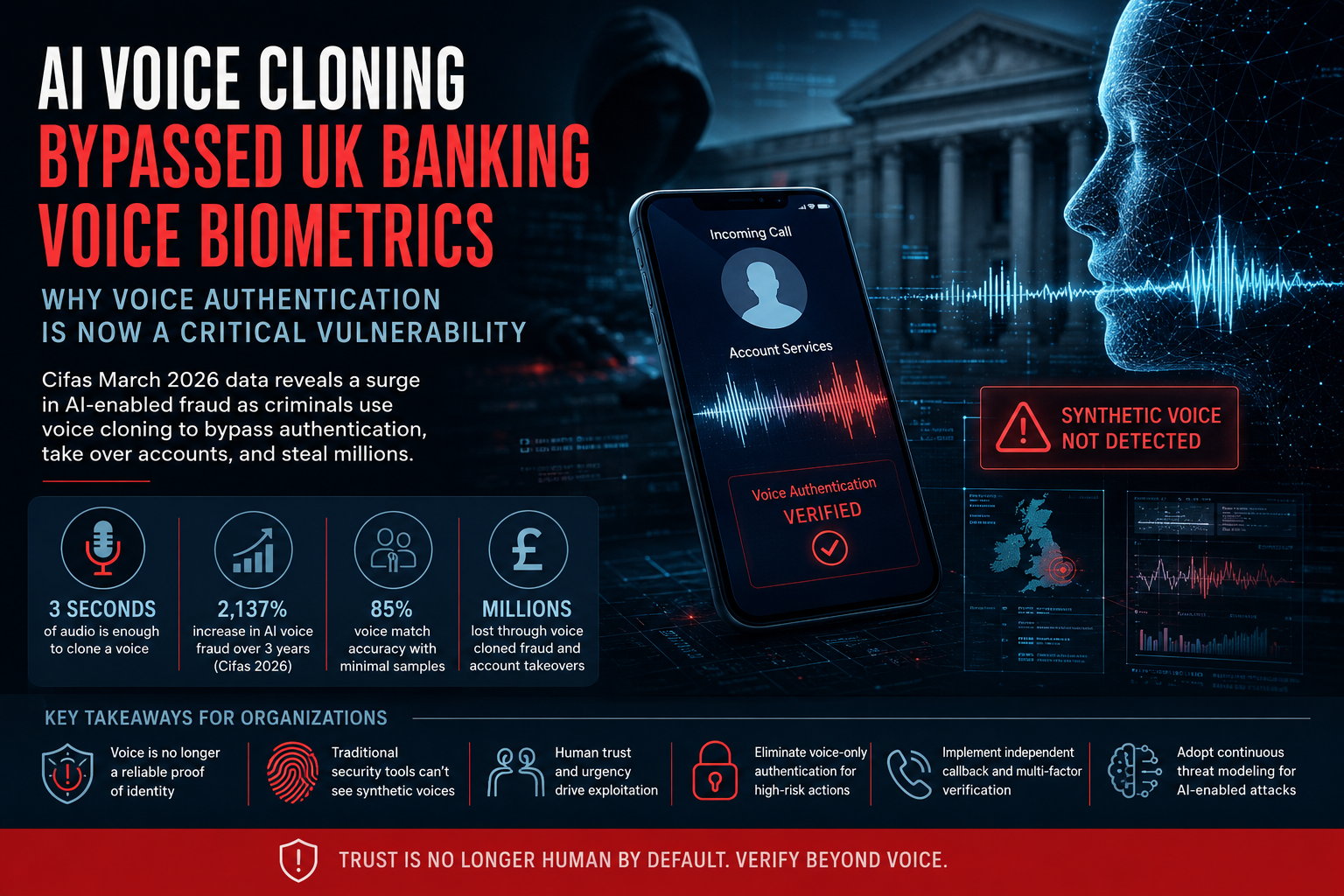
The March 2026 Cifas Fraudscape report highlighted the rapid growth of AI-enabled fraud and account takeover attacks across UK financial services. One of the most significant trends is the increasing use of AI-generated voice cloning to bypass voice authentication systems used by banks, contact centres, and financial institutions.
The issue is not simply that AI can imitate a human voice. The deeper problem is architectural.
Many authentication systems were designed around the assumption that a voice could function as reliable proof of identity. Advances in generative AI have eroded that assumption considerably. Modern voice synthesis systems can generate highly convincing speech from as little as a short audio sample — publicly available through videos, webinars, podcasts, earnings calls, voicemail greetings, and social media content.
This creates a growing operational risk for organisations relying on voice authentication for account access, transaction approvals, password resets, or identity verification workflows.
The challenge is not limited to banking. Any industry using voice as a trust signal now faces increasing exposure to synthetic identity attacks.
Threat Overview
AI-enabled impersonation attacks have increased considerably over the last several years within financial services, healthcare, legal, and enterprise environments.
Law enforcement agencies, including the FBI and Europol, have issued repeated warnings regarding AI-assisted business email compromise (BEC), synthetic identity fraud, and deepfake-enabled social engineering campaigns.
Recent research into voice biometric systems shows that modern AI-generated speech can reduce the effectiveness of traditional speaker verification systems, particularly where authentication workflows rely heavily on passive voice recognition.
This is not simply a fraud problem. It is an authentication trust problem.
Many existing authentication models were designed during a period when high-quality synthetic voice generation was expensive, technically difficult, and relatively rare. That assumption no longer holds.
Attack Chain Analysis
1. Voice Collection
Attackers first collect audio samples from publicly available sources. These commonly include:
• Podcasts
• Earnings calls
• Conference presentations
• Webinars
• Social media videos
• Voicemail greetings
• Recorded customer service calls
• nterviews and media appearances
Executives and finance personnel are particularly exposed because large quantities of high-quality speech data are already publicly accessible online. Modern AI systems can generate convincing synthetic speech from as little as a short audio sample.
2. AI Voice Cloning
The collected audio is processed using commercially available AI voice synthesis tools. These systems analyse vocal tone, speech cadence, pronunciation, accent, rhythm, and intonation patterns. The output is a synthetic voice capable of generating entirely new speech that resembles the original speaker.
Recent consumer testing and academic research indicate that many commercially available tools continue to lack strong safeguards preventing misuse or identity impersonation.
3. Identity Profiling
In parallel with voice collection, attackers gather contextual information about the victim from data breaches, social media, phishing campaigns, open-source intelligence, corporate websites, and professional networking platforms. This information helps attackers navigate security questions, build convincing scenarios, and mimic expected communication patterns and directly informs the targeting decisions made during voice collection.
4. Pretext Development
Attackers create believable operational scenarios before contacting the target organisation. Examples include:
• Urgent payment requests
• Password reset requests
• Requests to bypass verification due to travel
• Claims of lost device access
• Executive approval requests
The objective is to create psychological pressure that reduces verification rigour and encourages rapid action.
5. Contacting the Target
The attacker contacts a bank, service desk, finance team, or employee using AI-generated voice audio. Some attacks use real-time voice conversion tools, distinct from pre-synthesised cloning, that dynamically transform the attacker's live speech during a call. This enables interactive conversations capable of responding to questions in real time while maintaining the appearance of the legitimate speaker.
6. Bypassing Voice Authentication
Passive voice authentication systems compare vocal characteristics against stored voiceprints. These systems were primarily designed to recognise natural human speech patterns, not synthetic AI-generated replicas.
Recent research suggests that synthetic speech quality has improved to the point where many listeners struggle to reliably distinguish genuine speech from AI-generated audio during real-world interactions. Even where automated systems are not fully bypassed, human trust in familiar voices can still weaken secondary verification processes.
7. Credential Reset or Account Takeover
Once treated as a legitimate user, attackers may reset passwords, change phone numbers, add new payment recipients, disable fraud controls, authorise transactions, or escalate privileges. At this stage, account compromise becomes operationally difficult to distinguish from legitimate activity because the authentication workflow itself has already been trusted.
8. Fraud Execution
Attackers typically move rapidly once access is established. Common objectives include wire fraud, account takeover, payroll diversion, cryptocurrency transfers, supplier payment redirection, and data theft. Financial losses often occur before investigation or manual verification processes begin.
9. Persistence and Reuse
Unlike passwords, voices cannot easily be changed or revoked after compromise. Once a voiceprint is cloned, the exposure may persist across multiple systems and organisations using voice verification for identity confirmation. This transforms voice from a private biometric into a reusable digital artefact.
Why Traditional Security Controls Struggle
Many organisations assume existing security tooling will identify emerging authentication threats automatically. In practice, most traditional controls were not designed for AI-enabled identity impersonation attacks.
EDR Visibility Limitations
Endpoint Detection and Response (EDR) platforms monitor process execution, file activity, network connections, and malware behaviour. Voice authentication bypass typically occurs through telephony systems, contact centres, or application-layer workflows that EDR tools do not directly inspect.
SIEM Limitations
Security Information and Event Management (SIEM) systems ingest authentication logs showing successful authentication events. The logs themselves often appear legitimate because the authentication process technically completed successfully. Without additional contextual intelligence, SIEM correlation rules may have limited ability to distinguish synthetic identity abuse from genuine user activity.
IAM Blind Spots
Identity and Access Management (IAM) systems validate that authentication requirements were satisfied. If the authentication factor itself becomes unreliable, downstream IAM controls inherit that weakness.
The issue is not IAM failure. The issue is that the underlying voice trust signal has degraded — and IAM has no mechanism to detect that the factor it is relying on is no longer trustworthy.
Network Monitoring Challenges
Voice traffic frequently travels through standard telephony infrastructure, VoIP platforms, and encrypted communication channels. Traditional network inspection tools typically lack visibility into whether speech itself is synthetic.
Compliance and Configuration Gaps
Many vulnerable systems are technically configured correctly according to vendor guidance and compliance requirements — including frameworks such as PCI DSS and FFIEC authentication guidance. The weakness is architectural rather than operational. A system can remain fully compliant while still relying on outdated trust assumptions regarding voice authenticity.
Penetration Testing Limitations
Traditional penetration tests often focus on technical vulnerabilities, authentication bypass logic, infrastructure weaknesses, and application flaws. Many assessments still do not include AI voice synthesis attacks, real-time voice conversion testing, synthetic identity impersonation scenarios, or multimodal social engineering simulations. As a result, organisations may validate technical controls while missing weaknesses in human trust workflows and authentication assumptions.
Operational Challenges for Security Teams
Reliable Detection Remains Difficult
Recent studies suggest many synthetic voices are increasingly difficult for humans to identify consistently during live interactions. Detection systems also struggle to generalise across rapidly evolving synthesis models and audio generation techniques.
Behavioural Analysis Limitations
Traditional anomaly detection focuses heavily on device telemetry, login patterns, and malware indicators. Voice fraud frequently operates inside normal communication workflows, making deviations harder to identify.
Multi-Channel Complexity
Modern attacks increasingly combine email, voice, video, and messaging platforms. Each individual interaction may appear low-risk in isolation while collectively contributing to a successful fraud sequence.
Time Constraints
Financial fraud often executes faster than investigation cycles. By the time suspicious activity is escalated, funds may already have transferred through mule accounts or external payment systems.
Continuous Threat Modelling Failures
One of the largest operational gaps is the absence of continuous threat modelling around AI-enabled authentication threats. Many organisations dont conduct threat modelling, those that do still conduct threat modelling as a point-in-time architecture exercise rather than an ongoing operational discipline. This creates a mismatch between rapidly evolving AI capabilities, static authentication assumptions, and slow security review cycles.
Security teams frequently maintain controls designed for traditional credential compromise while synthetic identity attacks exploit entirely different trust relationships. Threat modelling should continuously evaluate:
• Where voice acts as an authentication factor
• Which workflows depend on voice trust
• Which users represent high-value impersonation targets
• How AI-generated identity attacks could bypass current approval chains
• Which compensating controls fail if voice trust degrades
Without continuous reassessment, organisations risk operating outdated authentication models against rapidly evolving attack capabilities. That failure does not stay isolated. It cascades, degrading the reliability of monitoring, security testing, and design decisions, and ultimately undermining the development lifecycle from requirements gathering to deployment.
Industry Context
| Industry | Primary Exposure | Example AI Voice Fraud Scenario | Operational Challenge |
|---|---|---|---|
| Financial Services | Wire fraud, account takeover | Synthetic executive payment approvals | High transaction velocity |
| Healthcare | Prescription and patient data abuse | AI-generated physician verification | Urgency-driven workflows |
| Legal Services | Client fund diversion | Fake partner authorisation requests | Trust-based communications |
| Enterprise Technology | Privilege escalation | Cloned executive IT access or support requests | Remote communication dependency |
| Manufacturing | Supplier payment fraud | Synthetic supplier impersonation | Complex approval chains |
Recommended Security Responses
Organisations should increasingly treat voice as a weak trust signal rather than a standalone authentication factor. Recommended defensive measures are grouped below by type.
Technical Controls
• Eliminate voice-only authentication for high-risk transactions
• Deploy phishing-resistant multi-factor authentication
• Introduce hardware-backed device verification
• Apply transaction risk scoring and velocity controls
• Deploy cross-channel fraud correlation monitoring
Process Controls
• Require independent callback verification for sensitive requests, this means calling back on a known, pre-registered number, not a number provided during the suspicious call itself
• Require secondary approval via an out-of-band verification channel for all financial transactions
• Expand penetration testing scope to include synthetic identity scenarios, AI voice synthesis attacks, and real-time voice conversion testing
Organisational Measures
• Conduct continuous AI-focused threat modelling exercises
• Train employees specifically on AI-generated impersonation risks
• Review whether existing workflows assume that familiarity with a voice equals verified identity, that assumption is becoming increasingly unreliable
Strategic Implications
The broader issue extends beyond voice cloning itself. AI-generated identity attacks challenge the long-standing assumption that human characteristics (voice, video, and behavioural familiarity) can reliably function as proof of identity.
As synthetic media quality improves, organisations may need to transition toward authentication models based more heavily on:
• Cryptographic verification
• Device identity
• Transaction context
• Behavioural consistency
• Risk-adaptive controls
• Independent out-of-band verification paths
The strategic risk is not that AI can imitate humans. The strategic risk is that many enterprise processes still treat human familiarity as sufficient authentication evidence.
Conclusion
Voice authentication is increasingly becoming an architectural risk rather than a convenience feature.
The problem is not that existing systems are poorly configured. The problem is that many authentication models were built on trust assumptions that generative AI is rapidly eroding.
Organisations continuing to rely heavily on voice biometrics should reassess whether those controls remain appropriate for modern threat environments.
Most importantly, security programmes should move away from static threat assumptions and toward continuous threat modelling capable of adapting to rapidly evolving AI-enabled attack techniques.
The operational challenge is no longer simply detecting fraud. It is redesigning authentication and trust workflows for a world where synthetic identity generation has become widely accessible, scalable, and increasingly convincing.
Further Reading
Our Blog - AI Threats & Fraud Intelligence | LLM Security & Deepfake Defense
• Shadow AI Risk: Why AI Security Starts with Asset Discovery | Hackerstorm
• Synthetic Identity Fraud Detection & AI Impersonation | Hackerstorm
• Voice Fraud Detection for Banks: Defending Against AI Clones | Hackerstorm
• AI impersonation & synthetic identity threats enterprise detection risk guide 2026
• The $35 Million Voice Clone: How AI Voice Fraud Is Breaking Bank Security
• Patient Zero: The 2019 German CEO Voice Clone That Triggered a $40 Billion Fraud Wave
• One in Four Job Applicants Could Be Fake by 2028, Experts Warn
• $25 Million Lost to a Deepfake Scam - And Why Your Security Protocols Won’t Stop the Next One
• Threat Intelligence Brief: North Korean IT Worker Scheme Highlights AI-Enabled Insider Access Risk
About This Report
Reading Time: Approximately 15 minutes
Attribution Note
This analysis is based on publicly available reporting and security research summaries. Some technical details may change as additional information becomes available.
Author Information
Timur Mehmet | Founder & Lead Editor
Timur is a veteran Information Security professional with a career spanning over three decades. Since the 1990s, he has led security initiatives across high-stakes sectors, including Finance, Telecommunications, Media, and Energy. Professional qualifications over the years have included CISSP, ISO27000 Auditor, ITIL and technologies such as Networking, Operating Systems, PKI, Firewalls. For more information including independent citations and credentials, visit our About page.
Contact:
Editorial Standards
This article adheres to Hackerstorm.com's commitment to accuracy, independence, and transparency:
- Fact-Checking: All statistics and claims are verified against primary sources and authoritative reports
- Source Transparency: Original research sources and citations are provided in the References section below
- No Conflicts of Interest: This analysis is independent and not sponsored by any vendor or organization
- Corrections Policy: We correct errors promptly and transparently. Report inaccuracies to
This email address is being protected from spambots. You need JavaScript enabled to view it.
Editorial Policy: Ethics, Non-Bias, Fact Checking and Corrections
Learn More: About Hackerstorm.com | FAQs
Source Transparency
• Cifas Fraudscape Report 2026
• FBI Internet Crime Complaint Center (IC3)
• NIST Special Publication 800-63-4 (2024)
• CISA Cybersecurity Advisories
• FFIEC Authentication Guidance
• Research on Voice Biometric System Vulnerabilities
• Consumer Reports AI Voice Cloning Analysis
• International AI Safety Report 2026