
AI Agents Are Expanding the Enterprise Attack Surface, Even When Everything Is Patched | HackerStorm
- Details
- 2026-09-11 10:26:04
The CISA Known Exploited Vulnerabilities (KEV) Catalog continued expanding throughout 2025 as ransomware groups, criminal operators, and state-sponsored actors increasingly prioritized exploitation of known vulnerabilities for initial access.
What is a CISA KEV? A Known Exploited Vulnerability (KEV) is a CVE confirmed by CISA as actively exploited in real-world attacks. Unlike CVSS severity scores, which measure theoretical impact, KEV status confirms that exploitation has already been observed in the wild. CISA mandates remediation deadlines for US federal agencies and publishes the catalog publicly at cisa.gov. Any vulnerability on the KEV list should be treated as an immediate remediation priority regardless of its CVSS score.
Industry reporting from incident response firms, CISA advisories, and threat intelligence providers consistently shows that exploitation of known vulnerabilities remains one of the most reliable and scalable attack paths used in enterprise intrusions.
The operational challenge is no longer intelligence collection.
Most organizations already receive:
• vendor advisories
• KEV notifications
• scanner output
• threat intelligence feeds
• exploit telemetry
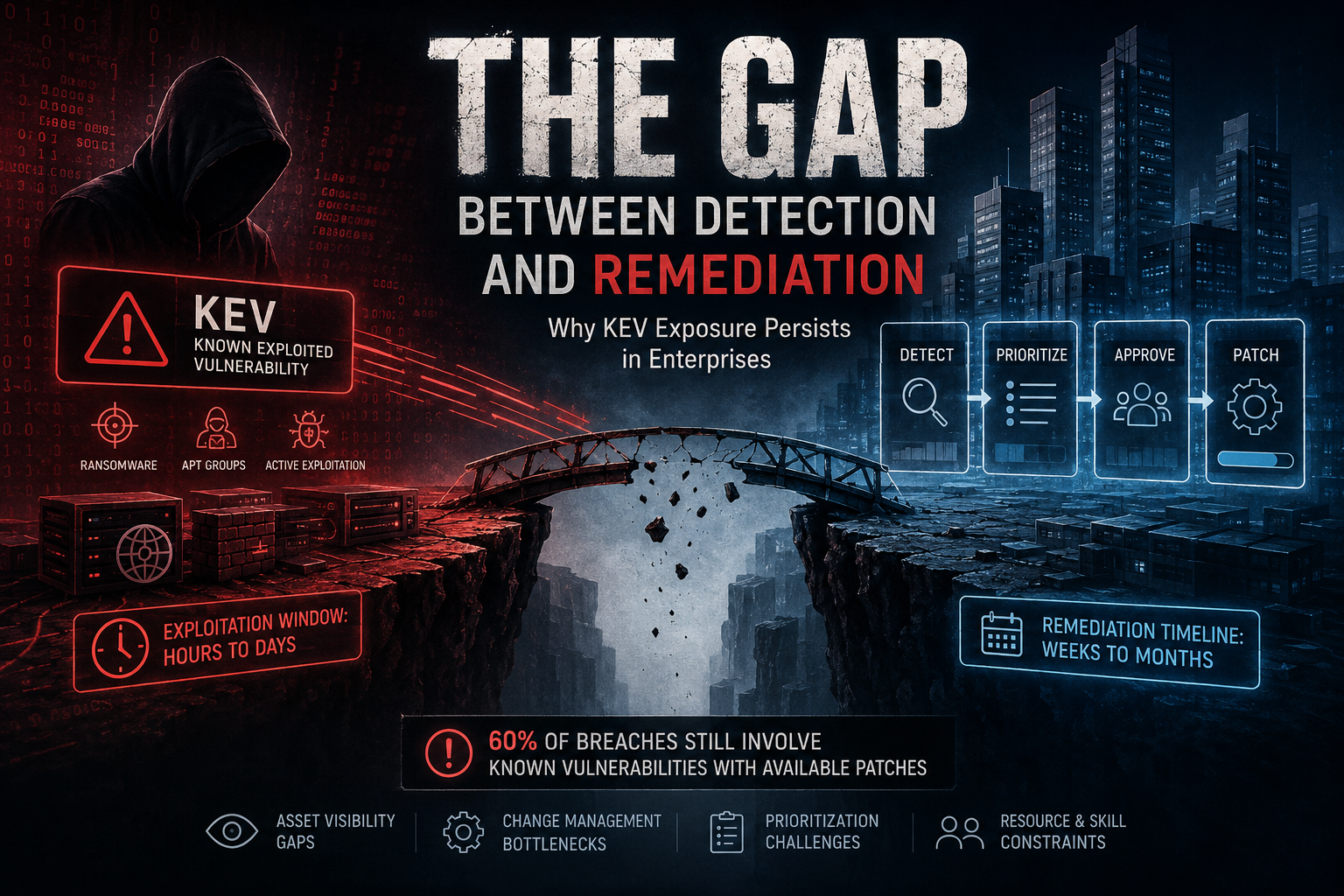
The challenge is operationalization: converting threat awareness into remediation action at attacker speed.
For many organizations:
• exploitation occurs within days of public disclosure
• emergency patching still takes weeks
• asset inventories remain incomplete
• internet-facing systems fall outside normal governance
• change management processes prioritize stability over remediation speed
The result is a persistent structural gap between vulnerability discovery and enterprise response capability.
Filter vulnerabilities and review threat intelligence to aid scheduling patch cycles.
Free hackerstorm Interactive Tool
Benchmark CVEs for Threat Prioritization
The Core Problem Is Operational Velocity
Most enterprises are not failing because they lack vulnerability intelligence.
They are failing because operational processes were built for a different era of threat activity — one where exploitation often occurred months after disclosure rather than immediately after public release.
Today, attackers:
• automate internet-wide scanning
• operationalize public proof-of-concept code rapidly
• prioritize edge devices and externally exposed systems
• exploit weaknesses before standard remediation cycles complete
Many enterprise environments still rely on:
• weekly CAB approvals
• multi-day testing windows
• fragmented asset ownership
• incomplete CMDB visibility
• siloed security and infrastructure teams
This creates a fundamental asymmetry between attacker speed and organizational response speed.
The Modern KEV Operational Landscape
| Operational Trend | Security Impact |
|---|---|
| Faster exploit weaponization | Reduces remediation windows from weeks to days |
| Growth in edge-device targeting | Bypasses traditional endpoint visibility |
| Increased ransomware use of KEVs | Makes patch prioritization business-critical |
| Hybrid cloud expansion | Creates visibility and ownership gaps |
| SaaS and API exposure | Introduces externally managed attack surfaces |
| OT/IoT convergence | Expands vulnerable infrastructure outside traditional IT governance |
Threat Overview
KEVs represent vulnerabilities with confirmed evidence of active exploitation.
The KEV catalog itself is not predictive, it is retrospective confirmation that exploitation activity has already been observed in the wild.
Recent exploitation trends show:
• increasing focus on VPNs, edge appliances, firewalls, and identity infrastructure
• rapid exploitation following public disclosure
• ransomware operators leveraging known vulnerabilities for scalable initial access
• increased targeting of internet-facing applications and remote management services
High-profile exploitation activity in recent years has included:
• CitrixBleed and CitrixBleed 2
• MOVEit Transfer exploitation
• Ivanti Connect Secure vulnerabilities
• Oracle E-Business Suite vulnerabilities
• Cisco IOS XE exploitation
• Log4Shell
• Spring4Shell
These incidents repeatedly demonstrate the same pattern:
1. public disclosure or exploit leak
2. rapid scanning activity
3. mass exploitation
4. delayed organizational remediation
5. post-exploitation persistence and lateral movement
1. Control Coverage Gaps
Many organizations assume:
• vulnerability scanners provide complete visibility
• EDR covers most attack surfaces
• SIEM ingestion is comprehensive
• annual pentests accurately represent current exposure
Operationally, this is often not the case.
2. EDR Limitations
Traditional EDR visibility is strongest on:
• workstations
• Windows servers
• managed endpoints
It is often weakest on:
• network appliances
• OT devices
• SaaS environments
• cloud control planes
• legacy infrastructure
• web applications
Exploitation of edge infrastructure may occur entirely outside endpoint telemetry coverage.
3. SIEM Logging Failures
Many organizations discover during incident response that:
• edge-device logs were not centralized
• application logs were incomplete
• cloud telemetry was disabled
• authentication events lacked retention
• internet-facing systems were outside logging scope
Detection quality is constrained by telemetry completeness.
4. Asset Inventory Gaps
Asset visibility remains one of the most persistent operational problems in enterprise security. Common blind spots include:
• shadow IT
• contractor-managed systems
• cloud workloads
• acquired infrastructure
• temporary internet-facing deployments
• unmanaged SaaS integrations
Organizations cannot remediate systems they do not know exist.
5. Prioritization Challenges
Traditional vulnerability prioritization often relies heavily on CVSS scoring. Operationally, exploitability matters more than theoretical severity.
A medium-severity vulnerability with:
• active exploitation
• public exploit code
• ransomware targeting
• internet exposure
may represent greater immediate risk than a higher CVSS vulnerability with no observed exploitation activity.
1. Detection Timing Problems
Modern exploitation frequently occurs:
• immediately after disclosure
• before organizations complete testing
• before CAB approval
• before maintenance windows open
This creates a recurring timing mismatch between attacker activity and enterprise remediation processes.
2. Change Management Friction
Many organizations still route emergency patching through:
• standard CAB processes
• multi-stage approval chains
• prolonged regression testing
• business-risk signoffs
These processes were designed for operational stability rather than high-velocity threat response.
3. Staffing and Capacity Constraints
Security and infrastructure teams frequently face:
• remediation backlogs
• limited maintenance windows
• fragmented ownership models
• shortage of skilled operational staff
• competing business priorities
This turns vulnerability management into a prioritization exercise rather than a complete remediation exercise.
1. Behavoural Indicators
• Unexpected outbound connections from edge infrastructure
• New process execution on appliances or web servers
• Service account activity outside normal patterns
• Authentication anomalies following public vulnerability disclosure
• Unusual application crashes or deserialization errors
2. Infrastructure Indicators
• Unauthorized web shells
• Unexpected listening ports
• Modified appliance configurations
• New scheduled tasks or persistence artifacts
• Presence of public exploit tooling artifacts
3. Process Indicators
• KEVs present on internet-facing systems
• Asset inventory discrepancies
• Long remediation windows for actively exploited vulnerabilities
• Missing telemetry from edge systems
• Delayed ownership assignment for critical exposure
1. Treat KEVs as Operational Emergencies
Organizations should establish a separate remediation path for:
• KEV-listed vulnerabilities
• internet-facing critical systems
• actively exploited edge infrastructure
These workflows should bypass standard patch prioritization queues.
2. Build Continuous Asset Visibility
Quarterly inventories are no longer sufficient. Recommended capabilities include:
• continuous asset discovery
• cloud workload visibility
• external attack surface monitoring
• CMDB validation
• network access control integration
3. Prioritize Exposure, Not Just Severity
Combine:
• KEV status
• EPSS scoring
• internet exposure
• identity exposure
• business criticality
to drive operational prioritization.
4. Improve Logging Around Internet-Facing Systems
Minimum telemetry should include:
• authentication logs
• web access logs
• appliance events
• cloud audit trails
• privileged access activity
Detection quality depends heavily on edge visibility.
5. Prepare Emergency Change Paths in Advance
Define:
• emergency remediation authority
• pre-approved maintenance processes
• rapid testing procedures
• rollback workflows
• executive escalation criteria
before major exploitation events occur.
Recommended Detection & Monitoring Workflow
| Operational Step | Objective |
|---|---|
| Monitor KEV additions daily | Rapid exposure awareness |
| Cross-reference against asset inventory | Identify affected systems |
| Validate internet exposure | Determine exploitability |
| Hunt for exploitation indicators | Detect compromise before patching |
| Apply temporary mitigations | Reduce exposure during remediation |
| Execute emergency patch workflow | Compress remediation timelines |
| Validate telemetry coverage | Ensure post-remediation visibility |
Recommended Prioritization Model
| Priority Factor | Why It Matters |
|---|---|
| KEV status | Confirms active exploitation |
| Internet exposure | Increases attacker accessibility |
| EPSS score | Estimates exploitation likelihood |
| Asset criticality | Measures business impact |
| Identity exposure | Increases lateral movement risk |
| Exploit availability | Accelerates attacker adoption |
| Compensating controls | May reduce practical exposure |
Several long-term trends are reshaping enterprise vulnerability management.
AI-Assisted Exploit Development
AI-assisted research is likely to accelerate:
• exploit discovery
• proof-of-concept generation
• vulnerability analysis
• attacker operational speed
This may further compress disclosure-to-exploitation timelines.
Expanding Attack Surface Complexity
Cloud, SaaS, APIs, remote work, IoT, and OT convergence continue expanding enterprise exposure faster than many organizations can operationalize visibility and governance.
The Shift Toward Exposure Management
Traditional vulnerability management programs focused heavily on:
• scan completion
• patch percentages
• compliance metrics
Modern exposure management increasingly requires:
• continuous validation
• attack surface awareness
• exploitability analysis
• operational prioritization
• identity-centric security controls
Further reading to ensure you understand other related failures because failures are opportunities for learning and improving.
The operational asymmetry between attackers and defenders continues to widen.
Attackers:
• automate reconnaissance
• operationalize exploit code rapidly
• target externally exposed systems
• exploit governance delays
Defenders still operate through:
• approval chains
• fragmented ownership
• incomplete inventories
• constrained maintenance windows
• operational risk concerns
The result is not simply a patching problem, it is an organizational velocity problem.
Many enterprises already possess:
• scanner coverage
• threat intelligence
• vulnerability feeds
• remediation tooling
What they often lack is the operational authority and process design necessary to act quickly against active exploitation. The organizations most likely to improve outcomes will not necessarily be those with the largest security stacks.
They will be organizations that:
• improve asset visibility
• reduce remediation friction
• operationalize exposure-based prioritization
• streamline emergency change authority
• integrate vulnerability intelligence directly into operational workflows
The modern challenge is not patching everything.
The challenge is identifying which exposures matter most operationally and reducing attacker opportunity before exploitation occurs.
Reading Time: Approximately 15 minutes
This analysis combines:
• public KEV reporting
• incident response research
• threat intelligence reporting
• operational vulnerability management observations
• publicly documented exploitation case studies
Operational recommendations are intended to support security leaders, SOC teams, vulnerability management programs, infrastructure teams, and executive decision-makers evaluating enterprise remediation readiness.
Timur Mehmet | Founder & Lead Editor
Timur is a veteran Information Security professional with a career spanning over three decades. Since the 1990s, he has led security initiatives across high-stakes sectors, including Finance, Telecommunications, Media, and Energy. Professional qualifications over the years have included CISSP, ISO27000 Auditor, ITIL and technologies such as Networking, Operating Systems, PKI, Firewalls. For more information including independent citations and credentials, visit our About page.
Contact:
This article adheres to Hackerstorm.com's commitment to accuracy, independence, and transparency:
Editorial Policy: Ethics, Non-Bias, Fact Checking and Corrections
Learn More: About Hackerstorm.com | FAQs
• NIST National Vulnerability Database
• CrowdStrike Global Threat Report
• Palo Alto Unit 42 Incident Response Reports
COOKIE / PRIVACY POLICY: This website uses essential cookies required for basic site functionality. We also use analytics cookies to understand how the website is used. We do not use cookies for marketing or personalization, and we do not sell or share any personal data with third parties.