
Critical Threat Intelligence & Advisory Summaries
$25 Million Deepfake Heist: Why 'Perfect' Compliance is Failing Enterprises in 2026
Timur Mehmet
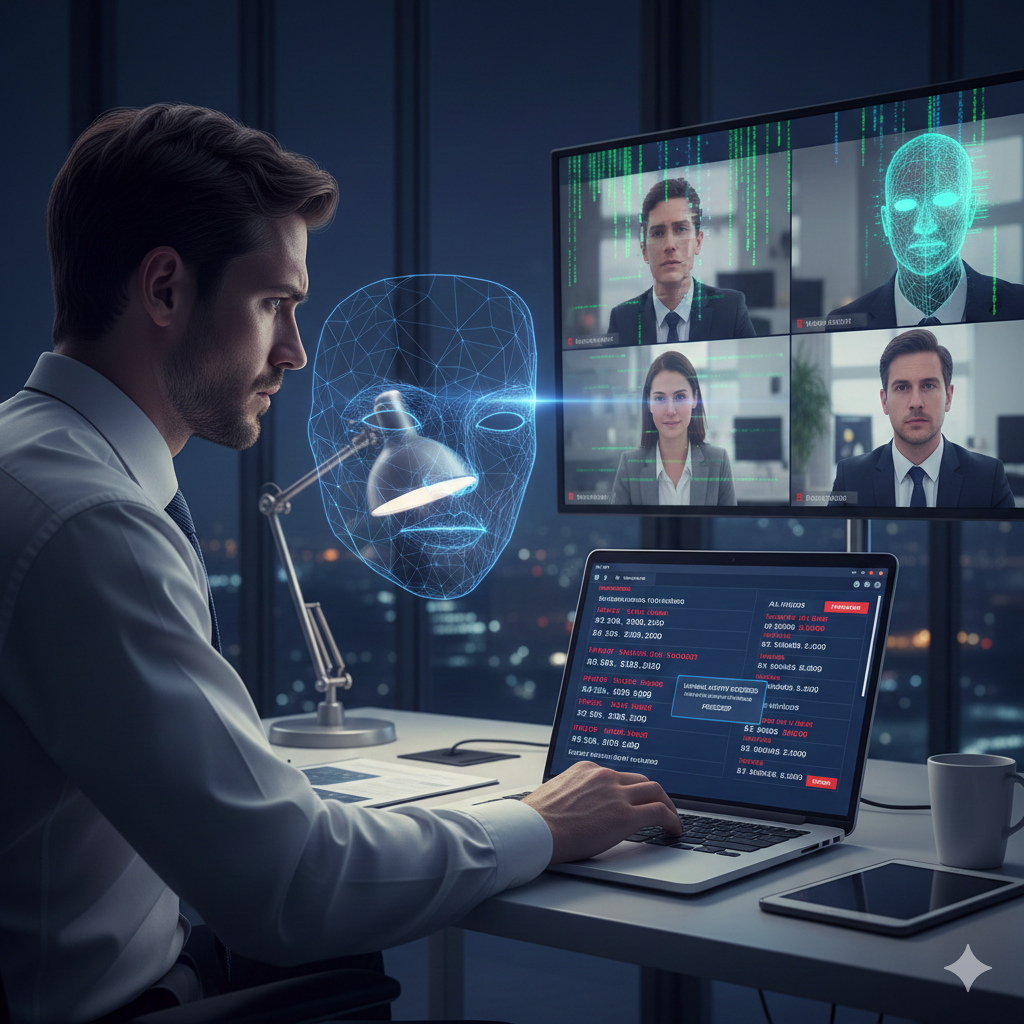
HONG KONG — A finance worker at the multinational engineering firm Arup authorized the transfer of $25.6 million (HK$200 million) in early 2024 after attending a video conference call with what appeared to be the company’s Chief Financial Officer and several colleagues. Despite her initial skepticism, the employee proceeded with 15 separate transfers to five different bank accounts because she "saw and heard" recognizable faces and voices on the live call. Hong Kong police later confirmed that every participant on the call, except the victim, was an AI-generated deepfake—marking a watershed moment where standard verification protocols became the primary vulnerability.
The Protocol as the Vulnerability
The Arup case shattered the long-held security assumption that "seeing is believing." The victim followed established company procedures: she questioned the initial "confidential" email, but then verified the request through a face-to-face (albeit virtual) meeting. Because the protocol relied on visual and auditory confirmation, sensory evidence that AI can now replicate in real time, the incident illustrates how “perfect compliance” with traditional verification methods can contribute to large-scale deepfake-enabled fraud.
Security experts call this "technology-enhanced social engineering." Security experts increasingly argue that many incidents stem less from employee negligence and more from adherence to security models that still treat video presence as a trusted identity factor.
The Breakdown of Human Trust
Similar risks have been documented globally. In a widely reported 2020 UAE case, a bank manager authorized $35 million after receiving a call from a “director” whose voice he recognized after years of working together. These cases highlight a psychological risk: when employees believe they are dealing with a trusted colleague, they may bypass secondary controls in an effort to be efficient and responsive.
According to the Entrust 2025 Identity Fraud Report, deepfake-related fraud attempts were detected globally at an average rate of roughly one every five minutes in 2024.. Furthermore, Gartner forecasts that by late 2026, as many as 30% of enterprises may no longer consider standalone identity verification sufficient on its own.
| Case/Statistic | Source (2024–2026) | Key Details |
| Arup ($25.6M Loss) | Arup Global / PRMIA | Confirmed in Feb 2024; the Hong Kong office was targeted via a multi-person deepfake video call. |
| KnowBe4 Hiring Case | KnowBe4 / HR Tech News | Disclosed in July 2024; involved a North Korean operative using AI-enhanced identity photos. |
| 3,000% Fraud Surge | Onfido / IBM Identity Report | Identity verification vendors reported dramatic year-over-year growth in deepfake-related fraud attempts, with some analyses citing increases of up to 3,000%. |
| Gartner 2026 Prediction | Gartner Research | Predicted that 30% of enterprises will distrust standalone IDV by 2026 due to injection attacks. |
| $40 Billion Loss Projection | Deloitte Center for Financial Services | Forecasts that GenAI-facilitated fraud will reach $40 billion annually by 2027. |
| UAE Bank ($35M Loss) | Forbes / UAE Authorities | The 2020 heist remains the benchmark for "Deep Voice" technology combined with social engineering. |
| 5-Minute Attack Rate | Entrust 2025 Fraud Report | Data indicates that a deepfake attempt occurred every five minutes globally throughout 2024. |
Layered Defense: The KnowBe4 Case Study
While visual checks are failing, "behavioral" and "layered" defenses are proving effective. When the cybersecurity firm KnowBe4 inadvertently hired a deepfake-enhanced operative in 2024, their Security Operations Center (SOC) detected the threat within 25 minutes. The detection was not based on the operative's appearance—which had passed four video interviews—but on anomalous system activity that deviated from the expected behavior of a new hire.
The 2026 Universal Control Framework
To mitigate emerging risks from increasingly automated and AI-assisted fraud, organizations are moving toward a tiered control framework:
-
Out-of-Band (OOB) Verification: Never use the same channel to verify a request. If a video call requests a transfer, confirm it via an internal encrypted chat or a known office extension.
-
Mandatory Transaction Delays: Implement "cooling periods" for high-value transfers to neutralize the artificial urgency used by scammers.
-
No-Human-Override Policies: System-enforce verification steps so that social pressure from a "CFO" cannot force an employee to bypass security.
-
Cryptographic Provenance: Shift identity verification to zero-trust architectures using digital certificates and hardware keys rather than visual appearance.
2026 Deepfake Verification Checklist
This checklist should be standard operating procedure for all finance and HR departments.
| Category | Verification Action | Done |
| Initial Contact | If the request is "secret" or "urgent," immediately flag for OOB verification. | ☐ |
| Video Calls | Avoid relying on visual “liveness” challenges alone; modern deepfake systems can often replicate natural movement and camera interaction in real time. | ☐ |
| Audio Checks | Listen for unnatural "robotic" cadences or a lack of background noise. | ☐ |
| Identity Verification | Out-of-Band (OOB): Call the person back on a pre-verified, company-issued phone number. | ☐ |
| Process Control | Ensure Dual Authorization is required for any transfer exceeding your company's threshold. | ☐ |
| New Hires | For remote hires, cross-check LinkedIn footprints against verified portfolios (e.g., GitHub, Behance). | ☐ |
Conclusion: Beyond Sensory Trust
Many security analysts warn that the current “arms race” between deepfake generation and detection is increasingly challenging for defenders. As generative AI fraud losses are projected to hit $40 billion by 2027 (Deloitte), the only sustainable defense is a "verification-first" culture. Organizations must assume that all sensory evidence—no matter how recognizable—is compromised until it is authenticated through independent, non-visual channels.
About This Article
Last Updated: same as published
Reading Time: Approximately 15 minutes
Author Information
Timur Mehmet | Founder & Lead Editor
Timur is a veteran Information Security professional with a career spanning over three decades. Since the 1990s, he has led security initiatives across high-stakes sectors, including Finance, Telecommunications, Media, and Energy.
For more information including independent citations and credentials, visit our About page.
Contact:
Editorial Standards
This article adheres to Hackerstorm.com's commitment to accuracy, independence, and transparency:
- Fact-Checking: All statistics and claims are verified against primary sources and authoritative reports
- Source Transparency: Original research sources and citations are provided in the References section below
- No Conflicts of Interest: This analysis is independent and not sponsored by any vendor or organization
- Corrections Policy: We correct errors promptly and transparently. Report inaccuracies to
This email address is being protected from spambots. You need JavaScript enabled to view it.
Editorial Policy: Ethics, Non-Bias, Fact Checking and Corrections
Learn More: About Hackerstorm.com | FAQs
References
-
CNN. (2024, February 4). Finance worker pays out $25 million after video call with deepfake 'chief financial officer'. https://www.cnn.com/2024/02/04/asia/deepfake-cfo-scam-hong-kong-intl-hnk
-
DeepStrike. (2025). Deepfake Statistics 2025. https://deepstrike.io/blog/deepfake-statistics-2025
-
Variety. (2025). Deepfake fraud caused $200 million losses in Q1 2025. https://variety.com/2025/digital/news/deepfake-fraud-caused-200-million-losses-1236372068/
This article synthesizes findings from cybersecurity reports, academic research, vendor security advisories, and documented breach incidents to provide a comprehensive overview of the AI security threat landscape as of January 2026.