
Critical Threat Intelligence & Advisory Summaries
FIRST 2026 Forecast: Record-Breaking 59,000 CVEs Signal "Strategic Shift" for Security Teams
Timur Mehmet
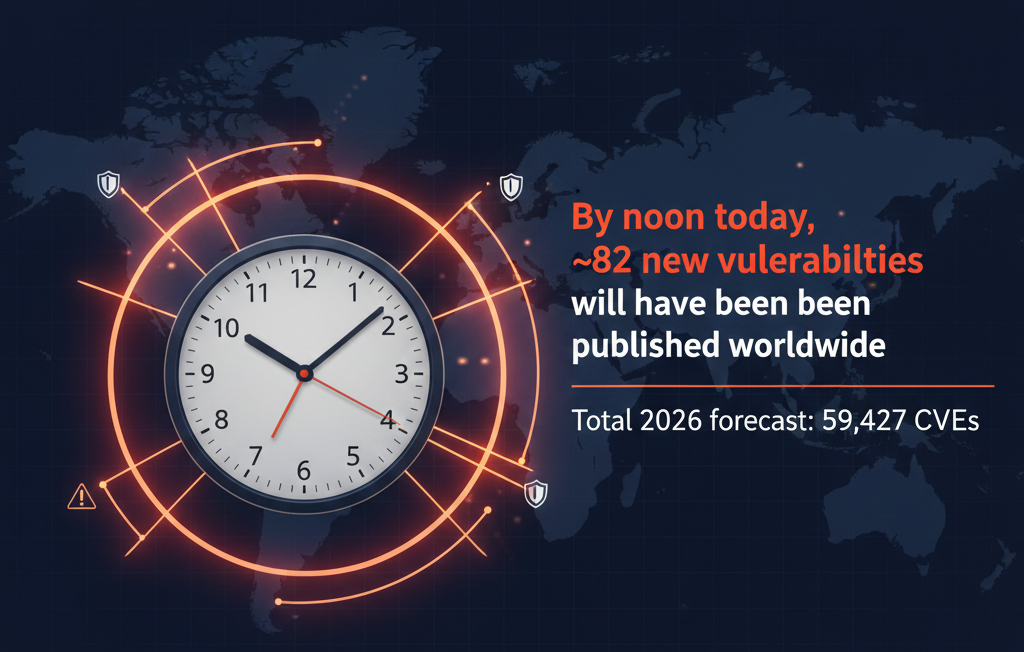
GENEVA, Switzerland - February 16, 2026 - The Forum of Incident Response and Security Teams (FIRST) has released its 2026 Vulnerability Forecast, projecting a record-breaking 59,427 new CVEs this year. This unprecedented volume marks the first time the industry is expected to surpass the 50,000-vulnerability threshold, demanding a fundamental transition from manual patching to machine-speed, risk-based prioritization.
GENEVA, Switzerland - February 16, 2026 - The Forum of Incident Response and Security Teams (FIRST) has released its 2026 Vulnerability Forecast, projecting a record-breaking 59,427 new CVEs this year. This unprecedented volume marks the first time the industry is expected to surpass the 50,000-vulnerability threshold, demanding a fundamental transition from manual patching to machine-speed, risk-based prioritization.
Why this matters: Organizations face more vulnerabilities than ever, many of which are exploited within hours of disclosure. Traditional patch cycles and manual triage will no longer suffice. Automation, threat intelligence, and risk-based prioritization are now essential for protecting critical assets.
This article will:
- Summarize FIRST’s forecast and its reliability
- Explain the operational impact of high-volume vulnerabilities
- Provide actionable strategies for prioritization, remediation, and planning
- Outline a multi-year approach for managing growing CVE volumes
Forecast Highlights: What FIRST Predicts for 2026–2028
- Median 2026 projection: 59,427 CVEs
- 90% confidence interval: 30,012 – 117,673 CVEs
- Three-year outlook: 51,018 CVEs (2027), 53,289 CVEs (2028), with upper-bound projections approaching 193,000
Éireann Leverett, FIRST lead researcher:
“The difference between preparing for 30,000 vulnerabilities and 100,000 is not merely operational—it’s strategic.”
The 2025 forecast was highly accurate, with a 7.48% Mean Absolute Percentage Error (MAPE), validating FIRST’s statistical approach. Security teams can now plan based on data rather than speculation.
| Forecast Year | Median Projection (CVEs) | Lower Bound (90% CI) | Upper Bound (90% CI) | Daily Average |
| 2026 | 59,427 | 30,012 | 117,673 | ~162 |
| 2027 | 51,018 | 25,124 | 103,501 | ~140 |
| 2028 | 53,289 | 24,960 | 113,822 | ~146 |
| 3-Year Total | 163,734 | 80,096 | 334,996 | — |
Note: Data derived from FIRST (Forum of Incident Response and Security Teams) 2026 Annual Report. The "Upper Bound" scenario for 2028 suggests a potential peak of up to 193,000 CVEs if current growth trends in third-party plugin vulnerabilities continue.
Understanding the Challenge: Volume and Velocity
Organizations will face:
- Daily average: 130+ new CVEs to triage, patch, or mitigate
- Peak days: “Patch Tuesday” remains busiest; Feb 26, 2025, saw ~800 CVEs published
- Exploit speed: 32.1% of Known Exploited Vulnerabilities (KEVs) were exploited on or before CVE publication day
Implications: Combining higher volume with faster exploitation eliminates traditional grace periods. Security teams must shift from reactive patching to proactive, intelligence-driven prioritization.
Changing Vulnerability Landscape: The WordPress Effect
- Third-party plugins now drive CVE volume, particularly WordPress plugins (Patchstack and Wordfence contributed 10,000+ CVEs in 2025)
- OS-level vulnerabilities are now only a small fraction of new CVEs
- Organizations tracking only core OS vulnerabilities risk missing the real drivers of exposure
The 0.2% That Matters
While tens of thousands of CVEs are published annually, only ~0.2% are actively exploited by ransomware or APTs.
Yet, 24.2% of organizations were exposed to CVEs actively used in attacks in 2024. This highlights a critical point: effective prioritization matters more than trying to patch everything.
Operational Framework: Four-Step Guidance for 50,000+ CVEs
To manage this unprecedented volume, organizations should follow a structured operational approach:
Filter to Active Exploitation
- Use the KEV catalog (~1,500 actively exploited vulnerabilities) to focus on immediate threats
- Federal agencies must comply with BOD 22-01; other organizations benefit from the same prioritization
Apply Environmental Context
- Layer CVSS Base scores with Threat and Environmental metrics
- Consider deployment environment, internet exposure, and compensating controls to adjust risk
Automate Low-Risk Patching
- AI-assisted vulnerability management, predictive patching, and policy-driven orchestration reduce exposure windows
- Transition from manual ticketing to automated remediation wherever possible
Decommission Unsupported Devices (EOS)
- Replace end-of-support hardware/software to prevent exploitation
- BOD 26-02 mandates this for federal networks; all organizations should follow the same principle
Three-Axis Prioritization: Severity, Intelligence, Environment
A risk-based scoring approach ensures that resources target the vulnerabilities that matter most:
| Axis | What it Measures | Example Inputs | |
|---|---|---|---|
| Severity | Worst-case impact | CVSS Base score (confidentiality, integrity, availability) | |
| Intelligence | Likelihood of exploitation | EPSS, KEV flags, threat intelligence feeds | |
| Environment | Organizational exposure | Asset criticality, internet exposure, compensating controls |
Composite scoring example:
0.4 CVSS + 0.4 EPSS + 0.2 KEV → normalized 0–1 score, with multipliers for critical assets or high-exposure systems
Outcome: Identify 10–50 high-priority vulnerabilities within thousands of alerts, cutting exposure windows from weeks to hours.
Planning for the Three-Year Horizon
- Treat 2026 as a structural shift, not a one-off spike
- Median CVE projections: 59,427 (2026) → 53,289 (2028)
- Upper-bound: up to 193,000 CVEs by 2028
Actionable guidance: Use this forecast to plan:
- Budget and headcount
- Tool selection and automation investment
- Multi-year vulnerability management program design
Intelligence & Metrics Requirements
To operate efficiently in this high-volume environment, organizations need:
- Automated CVE ingestion and initial classification
- Threat intelligence correlation to identify actively exploited vulnerabilities
- Asset inventory integration to map exposure
- Prioritization frameworks that surface the 0.2% critical CVEs
- Metrics to track time-to-patch for high-risk vulnerabilities
The operational model shifts from comprehensive patching to risk-based prioritization. With 130+ daily CVEs, equal urgency for every vulnerability is impossible.
Key Takeaways
- The 50,000+ CVE environment is unprecedented but manageable with structured frameworks
- Focus on the small subset of actively exploited vulnerabilities
- Adopt automation, threat intelligence, and three-axis prioritization
- Leverage FIRST’s forecasts for strategic, multi-year planning, not just reactive patching
Bottom line: The forecast provides the data; organizations must transform operations to act on it effectively.
About This Article
Last Updated: same as published
Reading Time: Approximately 15 minutes
Author Information
Timur Mehmet | Founder & Lead Editor
Timur is a veteran Information Security professional with a career spanning over three decades. Since the 1990s, he has led security initiatives across high-stakes sectors, including Finance, Telecommunications, Media, and Energy.
For more information including independent citations and credentials, visit our About page.
Contact:
Editorial Standards
This article adheres to Hackerstorm.com's commitment to accuracy, independence, and transparency:
- Fact-Checking: All statistics and claims are verified against primary sources and authoritative reports
- Source Transparency: Original research sources and citations are provided in the References section below
- No Conflicts of Interest: This analysis is independent and not sponsored by any vendor or organization
- Corrections Policy: We correct errors promptly and transparently. Report inaccuracies to
This email address is being protected from spambots. You need JavaScript enabled to view it.
Editorial Policy: Ethics, Non-Bias, Fact Checking and Corrections
Learn More: About Hackerstorm.com | FAQs
Editorial Note
This article is based on publicly reported incidents, government advisories, court records, and threat intelligence research from cybersecurity firms and industry analysts. Some figures cited are estimates derived from vendor reports and ongoing investigations. Information reflects the threat landscape as of February 2026.
References
Primary Sources
FIRST (Forum of Incident Response and Security Teams)
FIRST.org. "CVE Forecast Report 2026." Published February 11, 2026.
FIRST.org. "CVSS v4.0 Specification Document." https://www.first.org/cvss/specification-document
FIRST.org. "CVSS v4.0 Consumer Implementation Guide." January 2026. https://www.first.org/cvss/v4.0/implementation-guide
CISA (Cybersecurity and Infrastructure Security Agency)
CISA. "Known Exploited Vulnerabilities Catalog." https://www.cisa.gov/known-exploited-vulnerabilities-catalog
CISA. "Binding Operational Directive 22-01: Reducing the Significant Risk of Known Exploited Vulnerabilities."
CISA. "Binding Operational Directive 26-02: Mitigating Risk From End-of-Support Edge Devices." February 5, 2026. https://www.cisa.gov/news-events/directives/bod-26-02-mitigating-risk-end-support-edge-devices
CISA. "Emergency Directive 26-01: Mitigate Vulnerabilities in F5 Devices." October 15, 2025.
MITRE Corporation
MITRE. "Common Vulnerabilities and Exposures (CVE) Program." https://cve.mitre.org/
NIST National Vulnerability Database. "CVSS Vulnerability Metrics." https://nvd.nist.gov/vuln-metrics/cvss
Industry Analysis and Research
Vulnerability Management and Prioritization
Recorded Future. "Addressing the Vulnerability Prioritization Challenge."
Zafran. "Prioritizing Vulnerabilities: Best Practices for Risk-Based Patching." November 2025.
Balbix. "Understanding CVSS Base Scores." January 2025.
SecurityWeek. "New Paper and Tool Help Security Teams Move Beyond Blind Reliance on CISA's KEV Catalog." February 2026.
AI-Driven Patching and Automation
Google Research. "AI-powered Patching: The Future of Automated Vulnerability Fixes."
Red Hat Developer. "AI-driven Vulnerability Management with Red Hat Lightspeed MCP." January 2026.
TechTarget. "How AI-driven Patching Could Transform Cybersecurity."
The Hacker News. "When Attacks Come Faster Than Patches: Why 2026 Will be the Year of Machine-Speed Security." November 2025.
Patch Management Best Practices
DTF Creative Hub. "Patches in 2026: The Ultimate Guide to Patch Management." February 2026.
TuxCare. "Patch Management in 2026: Benefits, Best Practices & Tools." December 2025.
SentinelOne. "9 Vulnerability Remediation Tools in 2026." January 2026.
SentinelOne. "9 Vulnerability Management Tools in 2026." January 2026.
Government and Compliance
CISA. "BOD 19-02: Vulnerability Remediation Requirements for Internet-Accessible Systems."
Federal News Network. "CISA Tells Agencies to Identify, Upgrade Unsupported Edge Devices." February 2026.
Cybersecurity Dive. "CISA Orders Feds to Disconnect Unsupported Network Edge Devices." February 2026.
BleepingComputer. "CISA Orders Federal Agencies to Replace End-of-Life Edge Devices." February 2026.
Technical Documentation
FIRST.org. "CVSS v4.0 Examples." Version 1.6.1, January 2026.
FIRST.org. "CVSS v4.0 User Guide." https://www.first.org/cvss/v4.0/user-guide
Wikipedia. "Common Vulnerability Scoring System." Updated February 2026.