
Critical Threat Intelligence & Advisory Summaries
Patient Zero: The 2019 German CEO Voice Clone That Triggered a $40 Billion Fraud Wave
Timur Mehmet
In 2019, criminals cloned a CEO’s voice and exposed a fatal flaw in how organizations verify identity. Six years later, that same flaw is driving billions in AI-powered fraud losses.
The First Call: March 2019
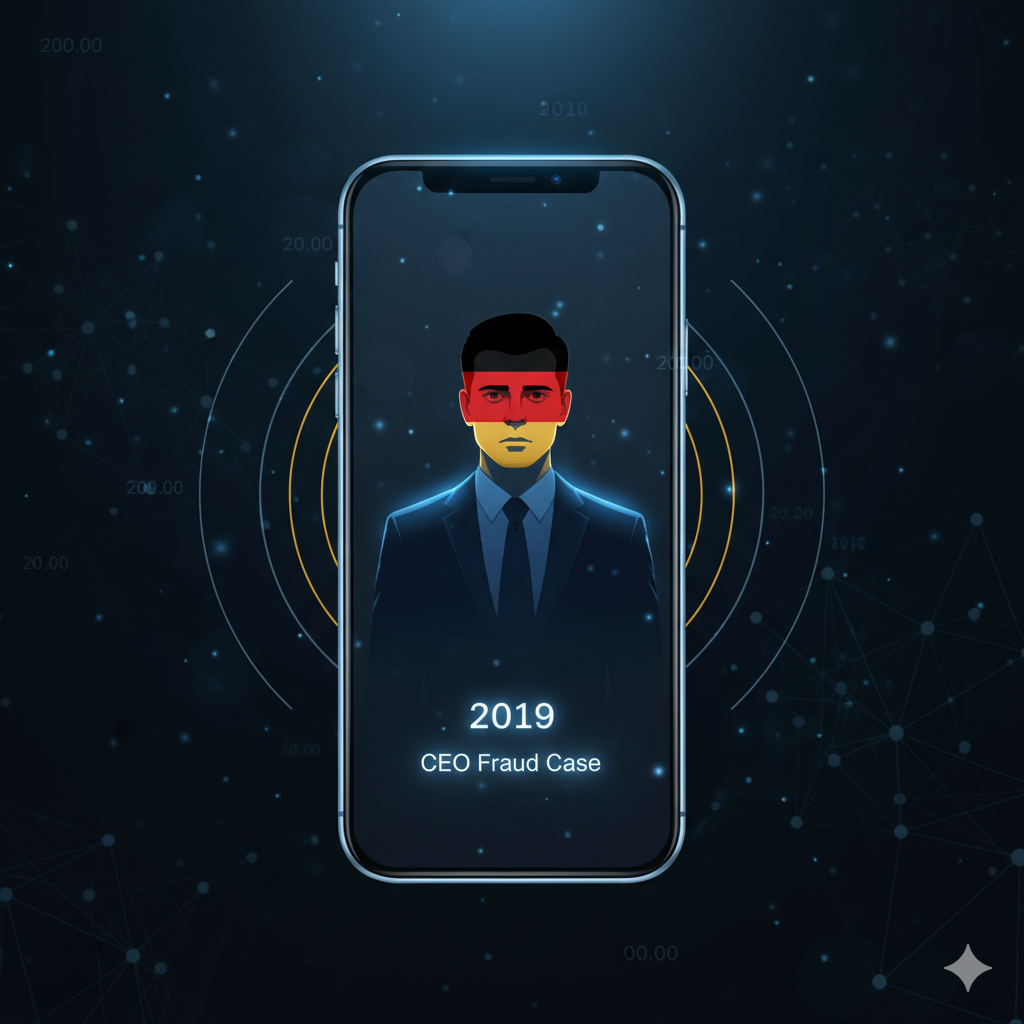
A UK subsidiary CEO answers his phone and hears his German boss on the line.
The accent is right.
The cadence matches.
The voice sounds exactly as it should.
The request is urgent but familiar: transfer €220,000 to a Hungarian supplier to close a deal.
He authorizes the payment.
The call comes again. The same voice. The same accent. The caller says the funds were reimbursed and asks for a second transfer.
Still sounds like the boss.
A third call follows. Another payment request.
This time, reality breaks.
The promised reimbursement never arrived. And the callback number now shows an Austrian prefix.
Reality no longer matches the voice.
This was patient zero for AI voice fraud. The first documented case where criminals used artificial intelligence to clone a CEO’s voice and steal money. Investigators later confirmed they had never seen cybercrime using AI voice spoofing before this incident.
Six years later, fraud losses enabled by generative AI are projected to reach $40 billion by 2027.
The warning came early. The systems did not change.
Why the 2019 Attack Worked
The UK executive was not careless. He relied on signals that had always worked before.
He recognized specific vocal markers that made the call appear legitimate:
- The German accent matched his boss’s speech pattern
- The melody of the voice replicated natural cadence
- The request aligned with normal business operations
- No obvious technical artifacts triggered suspicion
The attackers executed a multi-call strategy. The first call established the transaction. The second falsely claimed reimbursement to build trust. The third pushed for additional payment.
The fraud only collapsed when predicted reality diverged from observable reality.
The executive expected reimbursement. It never arrived. A second request before the first resolved violated basic business logic.
Then came physical proof.
While speaking to the real Johannes on his office phone, his mobile rang with another call from Johannes. When he asked who was calling, the line went dead.
Two simultaneous calls from the same person. Impossible.
Voice deception failed only when reality contradicted it.
The Technology Gap: 2019 vs 2025
In 2019, creating a convincing voice clone required technical expertise and specialized equipment. The German CEO attack represented the cutting edge of criminal capability.
That barrier no longer exists.
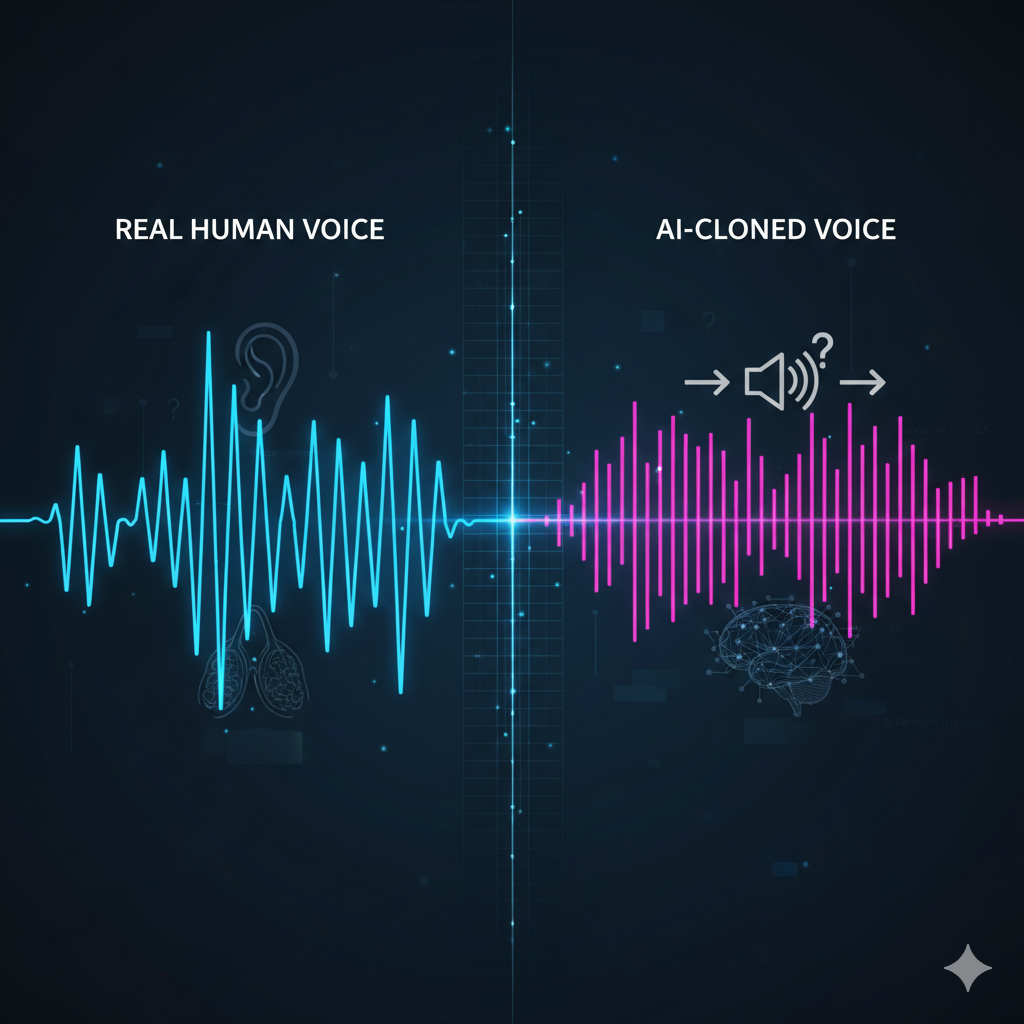
By 2025, modern voice cloning systems need as little as three seconds of audio and freely available tools. These systems replicate:
- Natural breathing patterns
- Emotional inflection and variation
- Laughter characteristics
- Filler words like "um" and "ah"
- Accent and dialect markers
Professional-grade AI voice cloning now achieves up to 97 percent accuracy.
Early generation clones sounded robotic and struggled with emotion. Trained ears could detect synthetic artifacts. Modern systems remove those tells entirely.
Humans cannot reliably detect them. Studies show people identify high-quality deepfake video correctly only 24.5 percent of the time. Audio-only detection rates hover between 60 and 70 percent. A 2025 study found just 0.1 percent of participants correctly identified all real and fake media shown.
Seventy percent of people admit they cannot confidently distinguish real voices from cloned ones.
From €220,000 to $25 Million
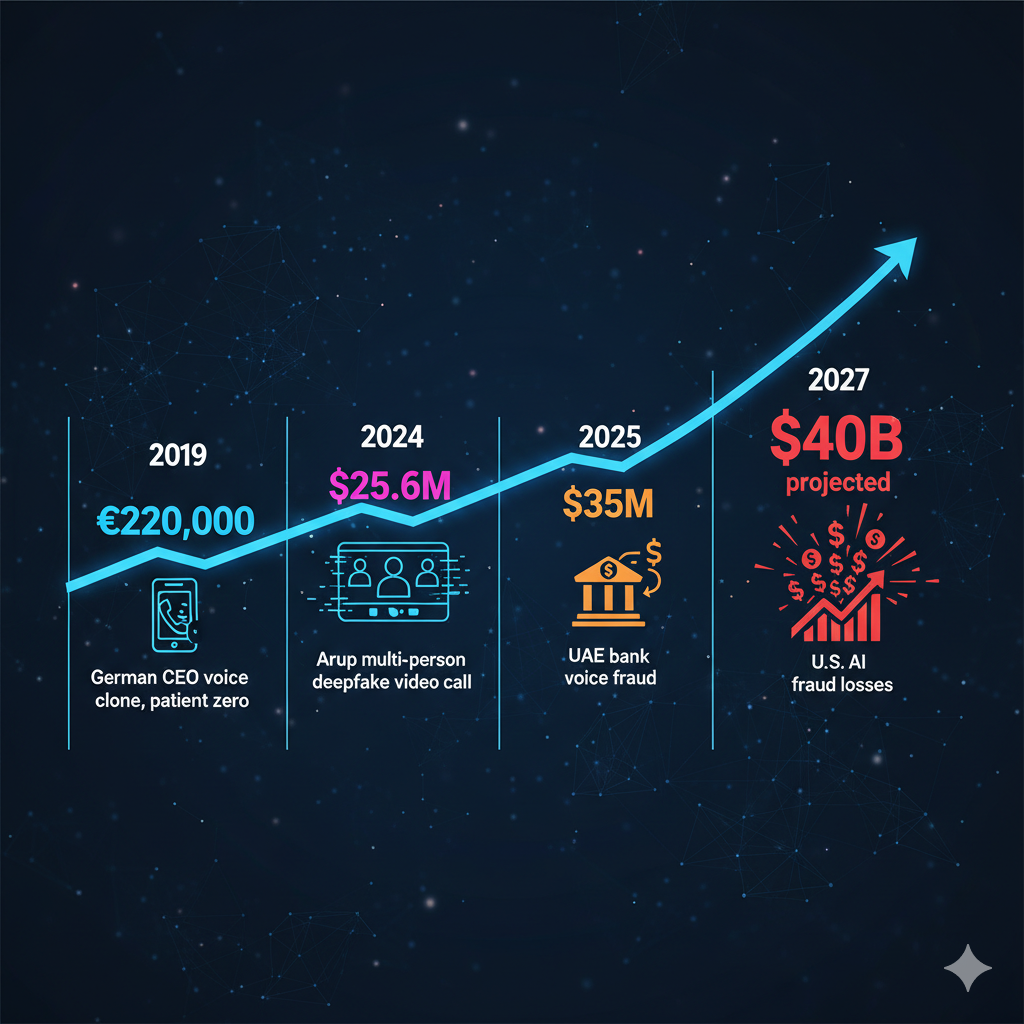
The 2019 case involved a single voice and €220,000.
The evolution since then has been exponential.
January 2024, Arup, a Hong Kong engineering firm. A finance worker joins a video call with the CFO and senior executives. Every participant is a deepfake. Faces move naturally. Voices match perfectly.
Fifteen wire transfers later, $25.6 million is gone.
The employee followed protocol: see face, hear voice, confirm match, proceed.
Perfect compliance with an obsolete security model. The protocol itself was the vulnerability.
The UAE banking case followed the same pattern. A manager authorized $35 million after recognizing the voice of a director he personally knew. He had emails, legal documentation, and authorization letters.
Every control existed. Human trust overrode them all. Controls are irrelevant when the human believes they know who they are talking to.
The Threat Landscape by the Numbers
- Deepfake attacks against businesses surged 3,000 percent in 2023
- Voice cloning fraud rose 680 percent in the past year alone
- Average loss per deepfake fraud incident exceeds $500,000
- Large enterprises average $680,000 per attack
- Global losses from deepfake-enabled fraud exceeded $200 million in Q1 2025
- Vishing attacks surged 442 percent in the second half of 2024
- Over 10 percent of banks suffered losses exceeding $1 million from deepfake voice fraud
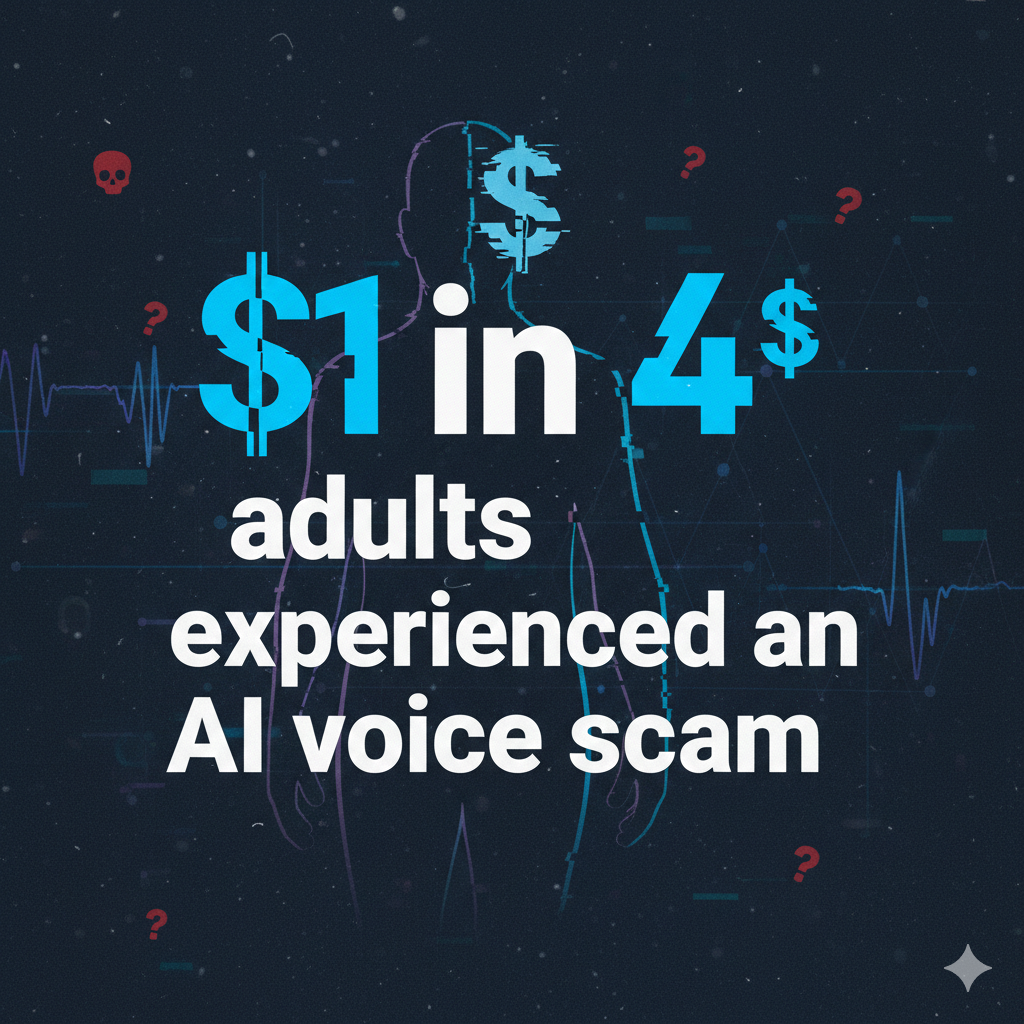
- One in four adults has experienced an AI voice scam
- Over three quarters of victims lost money, with many reporting lasting emotional damage
This is no longer an edge case. It is systematic exploitation.
Why Detection Failed Then and Still Fails
The German CEO victim did everything a reasonable person would do:
- Recognized voice patterns
- Assessed business context
- Evaluated the request against normal operations
His sensory evidence confirmed legitimacy.
The same failure pattern appears in every major deepfake fraud incident:
- Arup relied on video and voice confirmation without dual authorization
- UAE bank relied on voice familiarity supported by documents
- China video case relied on face and voice verification
Each followed protocol and lost money.
The assumption underlying all of them was identical:
If I can see you or hear you, I know who you are.
That assumption is false.
Controls That Would Have Stopped Every Case
Across five major incidents totaling over $60 million in losses, the same control failures repeat. Six mechanisms would have stopped every attack:
a. Out-of-band verification breaks single-channel deception
b. Dual authorization removes single-human failure
c. Transaction limits and delays neutralize urgency
d. No override policies eliminate social pressure exploits
e. Transaction-level multi-factor authentication requires proof beyond voice or video
f. Cryptographic identity verification makes impersonation irrelevant
The first three alone would have prevented most losses. These are not theoretical controls. They are operational decisions.
When Layered Defense Works: The KnowBe4 Case
In 2024, KnowBe4 hired a software engineer who passed four video interviews. Background checks cleared. The identity was stolen. Photos were AI-enhanced.
Detection occurred in 25 minutes.
Restricted access limited exposure. Heightened monitoring surfaced anomalies. SOC visibility caught what identity checks missed.
Assume controls will fail. Build layers that catch failures. That assumption saved them.
Lessons from Patient Zero
The 2019 German CEO voice clone revealed truths that still apply:
- Sensory evidence no longer proves identity
- Human trust override is the universal vulnerability
- Single-channel verification is inherently exploitable
- Urgency is always manipulation
- Reality contradictions expose fraud. Systems should create them
The technology gap closed years ago. The security architecture did not.
From €220,000 to $40 billion in six years. Patient zero showed the flaw. The next call is coming. The only question is whether the controls evolved before it arrives.
Next in this series: When Perfect Security Compliance Costs You $262,000
About This Article
Published: 04 February 2026
Last Updated: same as published
Reading Time: Approximately 15 minutes
Author Information
Timur Mehmet | Founder & Lead Editor
Timur is a veteran Information Security professional with a career spanning over three decades. Since the 1990s, he has led security initiatives across high-stakes sectors, including Finance, Telecommunications, Media, and Energy.
For more information including independent citations and credentials, visit our About page.
Contact:
Editorial Standards
This article adheres to Hackerstorm.com's commitment to accuracy, independence, and transparency:
- Fact-Checking: All statistics and claims are verified against primary sources and authoritative reports
- Source Transparency: Original research sources and citations are provided in the References section below
- No Conflicts of Interest: This analysis is independent and not sponsored by any vendor or organization
- Corrections Policy: We correct errors promptly and transparently. Report inaccuracies to
This email address is being protected from spambots. You need JavaScript enabled to view it.
Editorial Policy: Ethics, Non-Bias, Fact Checking and Corrections
Learn More: About Hackerstorm.com | FAQs
References
-
First documented AI voice clone fraud (German CEO case) — A voice deepfake was used to scam a UK energy company CEO out of a wire transfer after cloning a German parent company CEO’s voice. A Voice Deepfake Was Used To Scam A CEO Out Of $243,000 (Forbes)
-
AI voice cloning fraud context — Details on how fraudsters cloned a German CEO’s voice to initiate a fraudulent transfer and how the attack unfolded. Fraudsters clone CEO voice to steal USD 243,000 (AIAAIC)
-
Projected fraud losses from generative AI — Deloitte’s financial services outlook shows generative AI-enabled fraud losses could reach ~$40 billion in the U.S. by 2027, with an annual growth rate of ~32 percent. Deepfake banking and AI fraud risk (Deloitte Insights)
-
Deepfake voice cloning and financial loss statistics — Generative AI fraud trends showing average losses up to ~$680,000 per incident and deepfake fraud exceeding $200 million in early 2025. DeepFake AI Statistics By Fraud Data, Insights And Trend (Sci‑Tech Today)
-
Voice cloning market & fraud impact — Analysis highlighting how AI voice cloning contributes to financial scams and the increasing ease of creating convincing deepfakes. AI Voice Cloning Statistics 2026: Market and Accuracy Analysis (AllAboutAI)
-
Vishing and AI voice fraud growth trends — Recent data showing how vishing and voice phishing, fueled by AI voice cloning, are rapidly increasing and contributing to projected losses by 2027. Vishing Statistics 2025: Trends and Loss Projections (DeepStrike)
This article synthesizes findings from cybersecurity reports, academic research, vendor security advisories, and documented breach incidents to provide a comprehensive overview of the AI security threat landscape as of January 2026.