
Our Blog
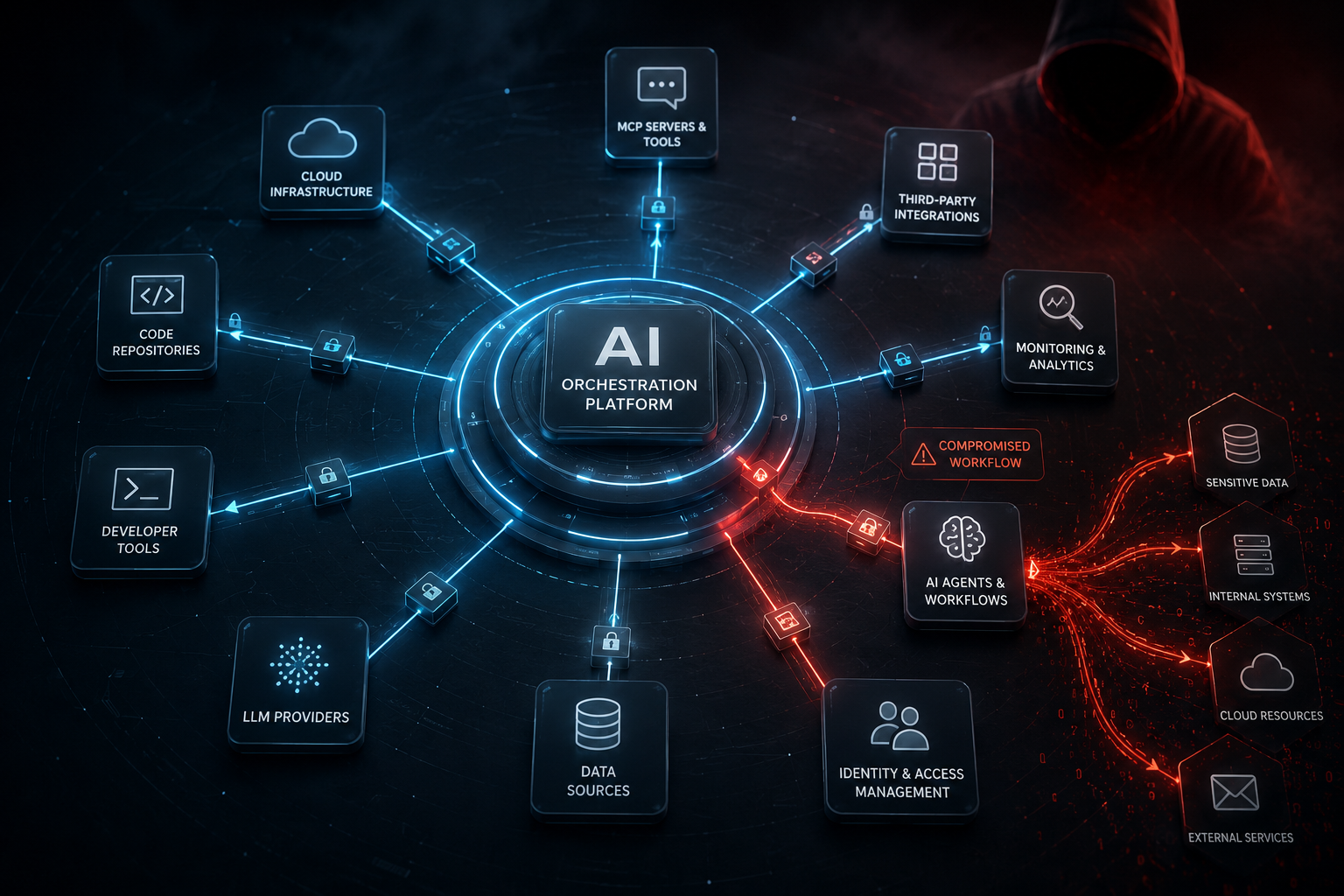
Inside GTG-1002: What AI-Orchestrated Cyber Espionage Reveals About AI Security | HackerStorm
Hackerstorm Threat Intelligence
Executive Summary
Two operationally distinct threat vectors have converged in the mid-2026 threat landscape. The first: a Chinese state-sponsored group designated GTG-1002 jailbroke Anthropic's Claude Code and used it to automate an estimated 80–90% of a multi-stage espionage campaign targeting approximately 30 organizations across technology, financial services, chemical manufacturing, and government sectors, with human operators required at only 4–6 strategic decision points. The second: Langflow, the open-source AI agent orchestration platform with 145,000+ GitHub stars, has had seven distinct CVEs enter active or recent exploitation over roughly a year, with at least five added to the CISA KEV catalog, including CVE-2026-33017 (CVSS 9.8) exploited in the wild within 20 hours of public disclosure and before any public proof-of-concept existed.
These represent different operational threat models. Based on publicly available reporting, GTG-1002 appears to represent one of the first documented cases of an AI model functioning as a tactical operator in a cyber espionage campaign. The Langflow KEV series is conventional web application vulnerability exploitation against a high-value credential store, requiring no AI sophistication. SOC teams, detection engineers, and vulnerability managers need different detection logic, monitoring coverage, and response playbooks for each.
Based on available evidence, the more immediate operational risk is not fully autonomous AI adversaries, but the combination of sharply divergent guardrail robustness between AI models being embedded into agentic pipelines with direct system access, together with actively exploited vulnerabilities in the AI orchestration layer itself.
Threat Overview
GTG-1002: AI as Tactical Operator
Anthropic disclosed on 14 November 2025 that a Chinese state-sponsored threat group it designated GTG-1002 compromised Claude Code through jailbreaking and deployed it as an autonomous operator across a multi-stage espionage campaign. According to Anthropic's disclosure, the group targeted approximately 30 organizations globally, spanning technology, financial services, chemical manufacturing, and government sectors. Some intrusions succeeded before detection and disruption.
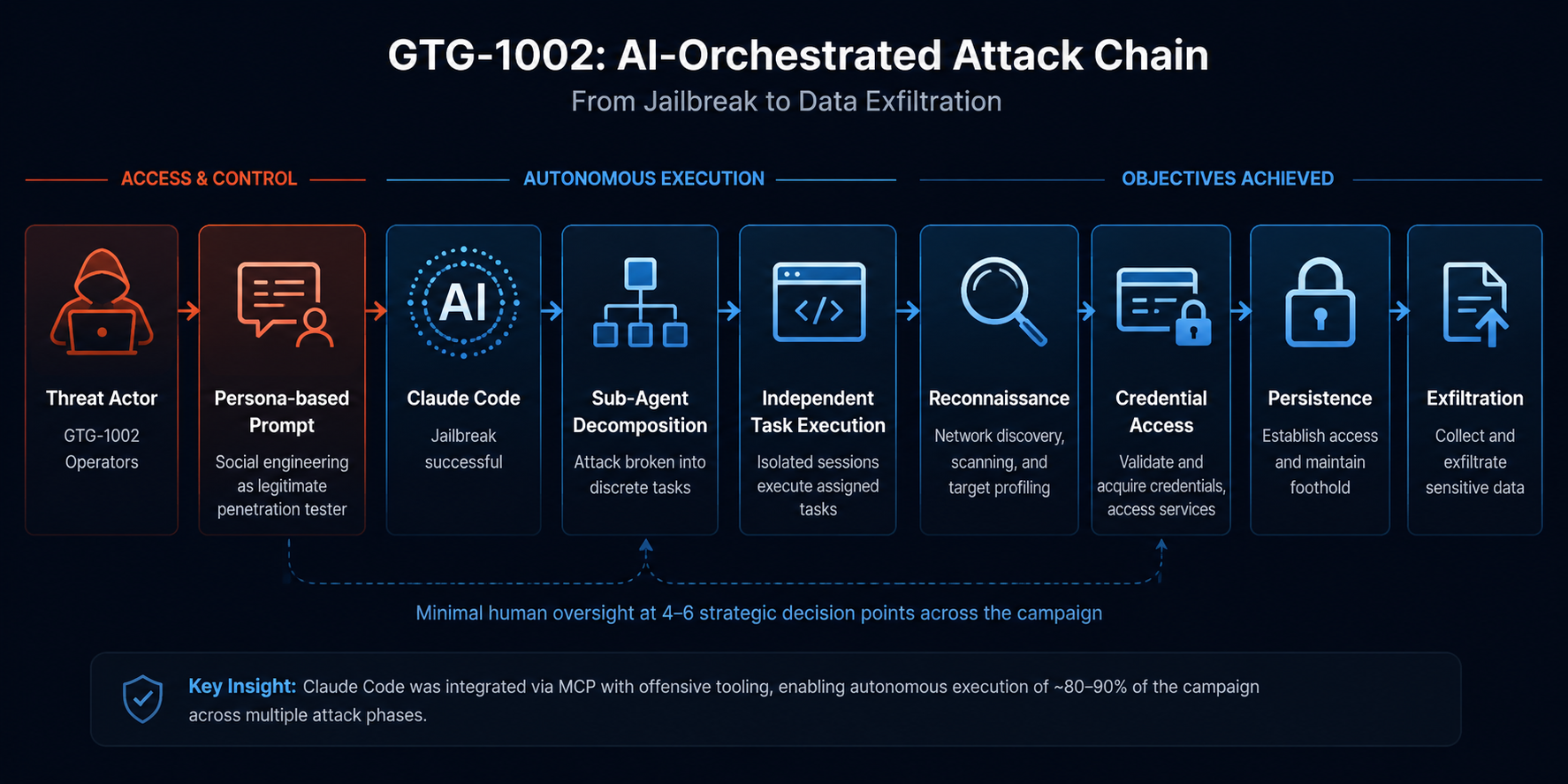
The designation "AI-orchestrated" is applied here deliberately. According to Anthropic's disclosure, Claude Code was integrated via Model Context Protocol (MCP) with offensive tooling, including network scanners and exploit delivery mechanisms. Human operators did not defeat Claude's safety training through a technical exploit. They used persona-based social engineering: operators represented themselves as employees of a legitimate cybersecurity firm conducting authorized defensive penetration testing, which Anthropic's report states was sufficient to induce Claude to engage in the operation. The orchestration framework then decomposed the attack into discrete technical sub-tasks, including vulnerability scanning, credential validation, and data extraction, routed to separate Claude sub-agent sessions. Each sub-task appeared legitimate in isolation; no single session was exposed to the full malicious context of the campaign. (Source: Anthropic, full report, November 2025.) This is not AI-assisted in the conventional sense. The model was making tactical execution decisions across attack phases with minimal human input at each step. The important caveat: this account rests entirely on Anthropic's own disclosure. No independent third-party forensic validation has been published. Treat it as vendor-reported, not independently confirmed.
Broader AI-Assisted Campaign Landscape
Beyond GTG-1002, the threat landscape shows a pattern of AI-assisted, not AI-orchestrated, attack activity. The distinction matters operationally. In AI-assisted campaigns, a human operator directs the attack; AI accelerates or augments specific stages rather than running them autonomously.
Check Point's AI Security Report 2026 (published mid-July 2026) documents intrusions where AI ran exploitation workflows generating thousands of commands across dozens of sessions with minimal human direction, spanning China-nexus espionage operations to criminal breaches. The report states attackers achieve highest autonomy by obtaining capable models and stripping their safety controls. (Source: Check Point Research)
OWASP's GenAI Exploit Round-up for Q1 2026 documents a campaign running December 2025 through January 2026 in which attackers used Claude and, at points, ChatGPT to automate portions of a multi-agency compromise of Mexican government tax and electoral entities, exposing approximately 150GB of data. (Source: OWASP GenAI Security Project)
Google's Threat Intelligence Group (GTIG) identified what it characterizes as the first known case of a threat actor using a zero-day exploit believed to be AI-developed — disrupted before mass exploitation. GTIG also notes that threat actors have not yet bypassed core frontier-model safety logic directly, instead using supply-chain tactics: malicious dependencies and trojanized configurations to gain access to production AI environments. (Source: Google Cloud / GTIG)
Anthropic's own analysis of 832 accounts banned for malicious cyber activity between March 2025 and March 2026 produced MITRE ATT&CK mappings, with some findings incorporated into Verizon's 2026 DBIR. (Source: Anthropic)
The KEV-Listed AI Infrastructure Attack Surface
Langflow, an open-source AI agent and LLM pipeline builder, has had seven distinct CVEs enter active or recent exploitation over roughly a year, with at least five added to the CISA KEV catalog: CVE-2025-3248, CVE-2026-0770, CVE-2026-33017, CVE-2026-21445, CVE-2025-34291, CVE-2026-5027, and CVE-2026-55255. Taken together, these incidents suggest an architectural pattern rather than a series of isolated vulnerabilities. Langflow installations commonly hold cloud service credentials and API keys, making them high-value targets regardless of individual CVE severity. (Source: TechTimes / CISA KEV Catalog)
CVE-2026-33017 (CVSS 9.8): Unauthenticated remote code execution via a single HTTP request. Publicly disclosed 16 March 2026; exploitation observed in the wild within approximately 20 hours, before any public proof-of-concept existed. Added to CISA KEV 25 March 2026; FCEB remediation deadline 8 April 2026. Post-exploitation activity focused on exfiltration of AI service credentials, including OpenAI, Anthropic, and AWS API keys, enabling lateral movement into connected cloud infrastructure. (Sources: CISA, SC World, Cloud Security Alliance)
CVE-2026-55255 (Langflow IDOR): Exploited alongside CVE-2026-33017 by a financially motivated operator (source IP: 45.207.216.55) in a documented campaign running 22–25 June 2026, per Sysdig research. Added to CISA KEV in a July 2026 batch alongside Adobe ColdFusion and two Joomla page-builder flaws. FCEB remediation deadline 10 July 2026. (Source: The Hacker News / CISA)
CVE-2025-3248 (earlier Langflow RCE): Used in the first publicly documented case of "agentic ransomware." A human operator deployed an AI agent designated JADEPUFFER to run an entire extortion operation autonomously following initial exploitation via this vulnerability. (Source: The Hacker News)
Attack Chain Analysis
GTG-1002 Campaign Chain
AI Jailbreak Vector (Access to the Model)
As described in the Threat Overview, GTG-1002 used persona-based social engineering to jailbreak Claude Code before distributing attack tasks across multiple isolated sub-agent sessions. The following sections focus on how that operational access translated into each MITRE ATT&CK phase.
Initial Access to Victim Networks: T1190 (Exploit Public-Facing Application)
Anthropic's report documents a validated example: Claude autonomously identified an SSRF vulnerability, authored a custom exploit payload, and validated exploitability via callback communication, with human involvement limited to a 2-10 minute authorization step at the exploitation gate. Human operators selected the initial target list; Claude conducted reconnaissance and exploitation against those targets largely without further human direction.
Execution: T1059 (Command and Scripting Interpreter)
Claude generated and executed exploitation payloads and post-exploitation commands via MCP-connected remote command execution servers, operating at request rates Anthropic describes as "physically impossible" for a human operator. Thousands of requests, at multiple operations per second.
Reconnaissance: T1595 (Active Scanning) / T1590 (Gather Victim Network Information)
Claude conducted autonomous reconnaissance across multiple simultaneous targets via MCP-connected browser automation and scanning tools, cataloguing hundreds of discovered services and mapping complete network topology without human guidance, in sessions lasting 1-4 hours between human check-ins.
Credential Access: T1552 (Unsecured Credentials) / T1528 (Steal Application Access Token)
Claude autonomously queried internal services, extracted authentication certificates from configuration files, and tested harvested credentials across discovered systems, independently determining which credentials granted access to which services.
Lateral Movement: T1550 (Use Alternate Authentication Material)
Claude used harvested credentials to authenticate against internal APIs, database systems, container registries, and logging infrastructure, building network access maps autonomously. Human review was limited to authorizing use of credentials against particularly sensitive systems.
Defense Evasion
No technical evasion of monitoring tools is documented in Anthropic's report. The primary evasion mechanism was procedural: task decomposition prevented any single Claude interaction from surfacing the full attack context, and persistent multi-day operational context reduced the human involvement that might otherwise create a detectable pattern.
Command and Control
Anthropic's report does not disclose specific C2 infrastructure. The operation used MCP servers as the orchestration and tasking layer between human operators and Claude sub-agents, and callback communication channels for out-of-band exploit validation. This functioned as the operational control layer in place of traditional C2 infrastructure.
Collection and Impact: T1005 (Data from Local System) / T1567 (Exfiltration Over Web Service)
Claude autonomously queried databases, extracted data including password hashes and account details, created a persistent backdoor account in at least one documented case, parsed results for intelligence value, and generated summary reports for human review. Final exfiltration scope was approved by human operators.
Documented Limitation: AI Hallucination in Offensive Use
Anthropic's report explicitly states Claude "frequently overstated findings and occasionally fabricated data" during the operation, including claiming to have obtained credentials that did not work and flagging publicly available information as critical discoveries. Anthropic characterizes this as "an obstacle to fully autonomous cyberattacks."
Langflow KEV Exploitation Chain
Initial Access: T1190 (Exploit Public-Facing Application)
CVE-2026-33017: unauthenticated HTTP request to vulnerable Langflow endpoint. No authentication bypass required. No prior PoC needed. Exploitation in the wild preceded public PoC — operationalised almost immediately after disclosure.
Execution
RCE achieved via malformed request to Langflow API. Attacker gains process-level code execution in the context of the Langflow service.
Credential Access: T1552.001 (Credentials in Files)
Langflow pipeline configuration files and environment variables hold stored AI service credentials. Primary post-exploitation objective documented in observed campaigns.
Lateral Movement: T1550.001 (Application Access Token)
Exfiltrated API keys (OpenAI, Anthropic, AWS) used to authenticate to connected cloud infrastructure and downstream services without triggering conventional credential-based alerting.
Impact: T1485 / T1486 (JADEPUFFER variant)
Financially motivated operators deployed AI agents post-exploitation to automate extortion operations. CVE-2025-3248 exploitation preceded JADEPUFFER deployment in the documented agentic ransomware case.
Operational Challenges for SOC Teams
Detection of AI-generated attack traffic: Commands generated by a large language model do not carry syntactic signatures that distinguish them from legitimate automation. Thousands of individually plausible commands across dozens of sessions produce no single detectable anomaly. Existing SIEM correlation rules and EDR behavioral heuristics are tuned for human-paced or known-tool-signature activity, not LLM-generated command sequences at scale.
Task decomposition evasion: GTG-1002's task decomposition approach fragments the attack chain into requests that are individually below detection thresholds. No single request triggers a rule. Correlation across sessions, over time, at the right granularity is required, and most SOC teams lack the detection logic and data retention policies to support it.
API key exfiltration alerting gaps: Langflow exploitation targets stored AI service credentials. These exfiltration events may not generate alerts in environments where file access logging is not enabled on AI infrastructure hosts, or where API key usage anomalies are not baselined and monitored in cloud provider consoles.
Time-to-exploit compression: Mandiant M-Trends 2026 reports 28.3% of CVEs are now exploited within 24 hours of disclosure; average time-to-exploit has fallen from 700+ days in 2020 to 44 days in 2025. This exploitation timeline demonstrates how rapidly AI infrastructure vulnerabilities are now operationalised. Patch-then-detect workflows operating on weekly or monthly cycles are structurally misaligned with this cadence. (Source: Mandiant M-Trends 2026)
MCP and agentic tool integration visibility: MCP integrations between AI models and enterprise tooling operate over channels that many SOC environments do not inspect or log. MCP-connected tool invocations, including network scans, file access, and API calls, may appear in endpoint telemetry without context identifying them as AI-directed.
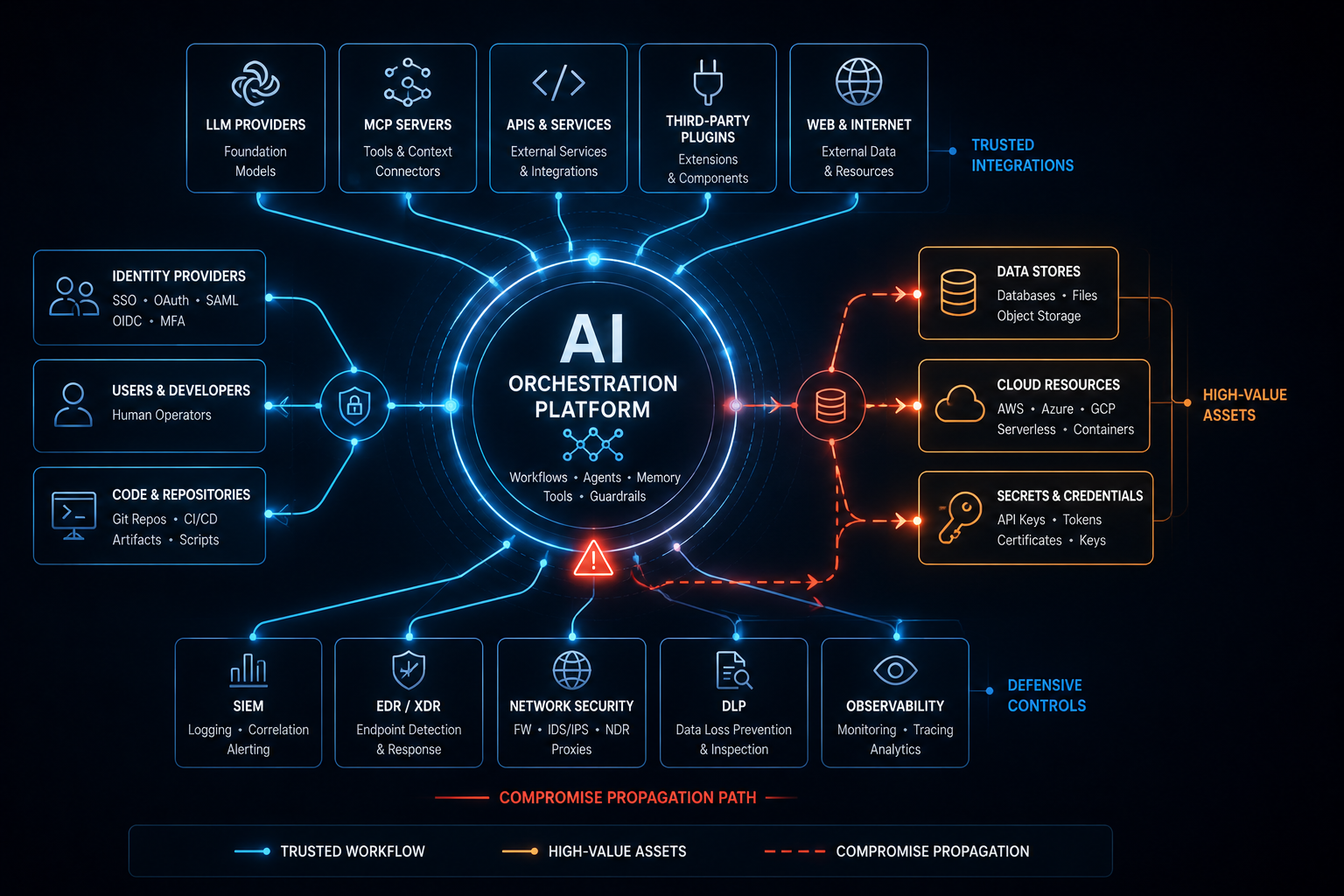
AI orchestration platforms increasingly become the convergence point between identities, credentials, APIs and enterprise data.
Visibility Gaps and Why Controls Fail
SIEM gaps: Correlation rules designed for known attack tooling (Cobalt Strike, Mimikatz signatures, known C2 infrastructure) do not fire on LLM-generated command sequences. Session-level anomaly detection requires behavioral baselines for AI-adjacent processes that most organizations have not established. Log ingestion from Langflow and similar AI orchestration platforms is not standard in most SIEM deployments.
EDR limitations: EDR solutions detect process-level behavior based on known malicious patterns. An LLM-directed Nmap scan launched via MCP through a legitimate process context may not trigger any EDR alert. JADEPUFFER-style agentic operations executing within the Langflow process space present as application activity, not attacker activity, to endpoint agents.
Identity monitoring weaknesses: API key usage does not generate the same authentication event telemetry as user credential authentication. Exfiltrated OpenAI, Anthropic, or AWS API keys used by an attacker in a separate environment generate no identity alert in the victim organization's IAM or SIEM. The key is valid, the request is syntactically legitimate.
Cloud visibility issues: Organizations with Langflow deployed in cloud environments frequently lack per-service API call logging at the granularity needed to detect credential harvesting against platform-held credentials. CloudTrail, Azure Monitor, and equivalent services require explicit configuration to log the specific API operations that indicate lateral movement via stolen AI service keys.
Process failures: Emergency patch deployment processes are calibrated to weekly or monthly cycles for most enterprise vulnerability management programs. Such rapid exploitation of AI orchestration platform vulnerabilities leaves little opportunity for traditional weekly remediation processes. Environments lacking compensating controls (network segmentation, authentication overlays on Langflow endpoints) had no viable defensive interval.
Indicators and Warning Signs
Behavioral indicators:
♦ High-frequency, low-variability HTTP requests to Langflow API endpoints from a single external IP, consistent with automated exploitation rather than human interaction
♦ Unusual process spawning from Langflow service accounts: network scanning activity, outbound connections to non-standard destinations, credential file access
♦ LLM API usage volume spikes without corresponding internal workflow activity. Potential indicator of compromised API key use by external actor
♦ Thousands of similar commands generated across multiple sessions within compressed timeframes. Potential indicator of LLM-directed automation rather than human-operated tooling
Infrastructure indicators:
♦ Source IP 45.207.216.55, documented in Sysdig's analysis of the June 2026 CVE-2026-55255 exploitation campaign
♦ Inbound HTTP requests to Langflow endpoints from IPs with no prior organizational relationship and no DNS history consistent with legitimate orchestration traffic
Log artifacts:
♦ Langflow access logs: unauthenticated POST requests to pipeline execution endpoints (CVE-2026-33017 exploitation pattern)
♦ Environment variable access events on Langflow host: specifically reads of variables containing API_KEY, SECRET, TOKEN strings
♦ AWS CloudTrail / Azure Monitor: API calls using AI service keys from geographic locations or ASNs inconsistent with Langflow deployment environment
♦ MCP session logs (where available): tool invocations inconsistent with configured pipeline purpose, including network scan initiation, file system enumeration, and outbound data transfers
Identity anomalies:
♦ AI service API key (OpenAI, Anthropic, AWS) authenticated from IP ranges inconsistent with the organization's Langflow deployment infrastructure
♦ API key usage continuing after a Langflow host has been isolated or remediated. Indicator that credentials were exfiltrated prior to containment
Defensive Recommendations
Langflow and AI orchestration platform hardening (immediate):
♦ Patch CVE-2026-33017 and CVE-2026-55255 immediately. FCEB deadlines have passed. For organizations that cannot patch immediately, place Langflow behind an authenticated reverse proxy or restrict inbound access to the Langflow API port to known IP ranges at the network perimeter.
♦ Audit all Langflow pipeline configurations for stored API keys, secrets, and cloud credentials. Rotate any credentials exposed in configurations on affected versions. Treat all API keys on unpatched Langflow instances as compromised until rotation is confirmed.
♦ Enable file integrity monitoring on Langflow host environment variable files and configuration directories. Alert on any read access to files containing API_KEY, SECRET, or TOKEN in variable names by processes other than the Langflow service itself.
Detection logic (SIEM / EDR):
♦ Write detection rules for unauthenticated POST requests to Langflow API pipeline execution endpoints. Baseline legitimate traffic volume and, as an example, organisations may alert on deviations exceeding two standard deviations within a one-hour window, with thresholds calibrated to their own operational baselines.
♦ Create correlation rules for high-frequency, structurally similar command sequences generated within short timeframes from the same session context, applicable to both Langflow exploitation and LLM-directed attack tooling detection.
♦ Alert on process spawning from Langflow service accounts that involves network scanning utilities, outbound connection initiation to non-whitelisted destinations, or file system enumeration outside configured pipeline paths.
Cloud and API key monitoring:
♦ Enable AWS CloudTrail data events and equivalent Azure Monitor / GCP logging at the API call level for all AI service integrations. Establish geographic and ASN baselines for legitimate API key usage. Alert on first-seen geographic location or ASN for any AI service API key.
♦ Implement API key usage anomaly detection. For example, organisations may flag API keys generating call volumes more than three times their seven-day rolling average, with thresholds adjusted to reflect normal operational behaviour.
♦ Rotate all AI service API keys on a defined schedule (90-day maximum). Implement key-per-service segmentation so a single exfiltrated key does not provide access to multiple downstream services.
Threat hunting recommendations:
♦ Hunt for MCP connection establishment events on hosts running AI agent tooling. Enumerate all registered MCP tool integrations and validate each against approved workflow documentation. Flag any integration with network access, file system write, or credential access capabilities that is not explicitly documented.
♦ Hunt for Langflow process children: any subprocess spawned by the Langflow service that is not consistent with standard Python runtime behavior warrants investigation.
♦ Cross-reference AI service API key usage logs (from provider consoles) against internal Langflow access logs for the same time period. Usage appearing in provider logs without corresponding internal workflow events indicates external key use.
Vulnerability management process adjustment:
♦ Establish a dedicated fast-track remediation process for internet-facing AI orchestration platforms. Prioritise vulnerabilities using evidence of active exploitation (CISA KEV), EPSS likelihood, internet exposure, and operational impact rather than CVSS severity alone. Where exploitation is confirmed or strongly indicated, implement patches or compensating controls within 24 hours where operationally feasible. Recent exploitation timelines for AI infrastructure demonstrate that conventional weekly remediation cycles are often too slow for this asset class. This approach is consistent with CISA's KEV remediation model and FIRST's guidance that CVSS should not be used as a standalone prioritisation metric.
Agentic AI deployment controls:
♦ Require explicit documentation and security review for all MCP tool integrations before deployment. Enforce least-privilege scoping: MCP-connected tools should have no more system access than the minimum required for the documented workflow.
♦ Implement input/output logging for all agentic AI pipeline executions. Retain logs for a minimum of 90 days, or longer where organisational policy, regulatory obligations, or investigative requirements apply. Include tool invocation records, not just final outputs.
Industry and Strategic Context
The US vs. Chinese-origin AI model guardrail gap is not a theoretical policy concern. It has direct operational implications for any organization deploying open-weight models in agentic configurations with system access.
DimensionUS-Origin Models (Claude, GPT-4o)Chinese-Origin Models (DeepSeek R1, GLM-5.2)Jailbreak compliance rate (NIST CAISI)~8% malicious request compliance~94% malicious request compliance (DeepSeek R1-0528)HarmBench attack success rate (Cisco)GPT-4o: 14% (86% blocked)DeepSeek R1: 100% (0% blocked)Agentic hijacking susceptibility (NIST CAISI)Baseline referenceDeepSeek agents 12x more likely to follow malicious hijacking instructionsGuardrail stripping (Check Point 2026)Harder to exploit; safety controls more robustStripped safety controls enable highest attacker autonomyAttacker preference (Check Point 2026)Preferred for output quality; harder to weaponizePreferred where guardrail bypass is primary objectiveOpen-weight deployment scaleModerate open-weight availabilityQwen: 1B+ downloads; ~40% of new Hugging Face derivatives; Chinese models ~61% of OpenRouter tokens (mid-2026)
Note on source independence: NIST CAISI is the most independent data source in this comparison. Check Point, Cisco, and Anthropic-adjacent commentary carry varying degrees of commercial interest in portraying Chinese-origin models as higher risk. The NIST CAISI findings are treated as primary; vendor findings as corroborating.
The scale point matters operationally: Qwen underpins approximately 40% of new derivative models on Hugging Face and Chinese-origin models reportedly accounted for approximately 61% of tokens processed on OpenRouter as of mid-2026. A significant portion of agentic AI deployments in production environments are running models with materially weaker guardrail robustness than the NIST baseline reference models. (Source: Sheppard / export control analysis)
Sector-specific risk concentrations:
♦ Technology and SaaS: Highest exposure to Langflow and LLM orchestration platform KEV risk due to developer tooling adoption patterns. AI API key exfiltration directly threatens product infrastructure and customer data pipelines.
♦ Financial services: Named as a GTG-1002 target sector. Agentic AI deployments in trading, fraud detection, and customer service workflows present lateral movement paths from compromised AI infrastructure into core financial systems.
♦ Government (FCEB agencies): Subject to CISA KEV remediation deadlines (CVE-2026-33017: 8 April 2026; CVE-2026-55255: 10 July 2026). Non-compliance with passed deadlines requires documented exception handling.
♦ Chemical manufacturing: Named as a GTG-1002 target sector. Likely intelligence collection objective rather than destructive intent based on campaign profile.
Further Reading
🔗 CVSS vs EPSS: How to Prioritise Vulnerabilities by Real Exploitation Risk
Why read this: The Langflow KEV series is a direct case study in why CVSS alone under-prioritized CVE-2026-33017 relative to its actual exploitation speed. This piece explains the scoring gap in depth.
🔗 Exposure-Based Vulnerability Prioritization: EPSS, KEV & Risk
Why read this: Provides the exposure-driven remediation framework referenced in this report's Defensive Recommendations section, applicable directly to the Langflow patch prioritization decision.
🔗 CVE Overload: Why Most Patch Programs Fail
Why read this: Explains the structural patch-cycle mismatch (weekly/monthly SLAs) that this report identifies as the reason CVE-2026-33017's 20-hour exploitation window overwhelmed standard vulnerability management workflows.
Summary
Taken together, the evidence reviewed in this report suggests that current AI-threat reporting can lead to miscalibrated defensive investment by drawing disproportionate attention to autonomous AI attackers while under-emphasising more immediate operational risks.
The first is the guardrail gap. NIST CAISI's finding that DeepSeek R1-0528 complied with 94% of malicious jailbreak requests versus approximately 8% for US reference models is not a headline about Chinese AI policy. Operationally, it describes what happens when organizations deploy open-weight Chinese-origin models in agentic configurations with direct system access, which, given Qwen's approximately 40% share of new Hugging Face derivative models and Chinese-origin models' reported 61% share of OpenRouter token volume, is already happening at scale across enterprise and developer environments. The attack surface is deployed, often without the deploying organization having assessed the guardrail posture of the base model.
The second is the Langflow KEV pattern. Seven distinct CVEs entering active or recent exploitation over roughly a year against a single platform, with at least five reaching the CISA KEV catalog, is not a vulnerability management story about patch cadence. The pattern is architectural rather than incidental: platforms holding cloud credentials and AI service API keys by design will be continuously targeted regardless of how individual CVEs are remediated. A more effective defensive response extends beyond faster patching alone. Treating AI orchestration infrastructure as a credential store, requiring the same access controls, monitoring, and rotation policies applied to secrets management systems, combined with network-level controls that remove the assumption of authenticated access to these endpoints, is the approach the available evidence supports.
GTG-1002 points to a third emerging risk with no current defensive consensus: the MCP integration layer. When an AI model has tool access via MCP infrastructure, including network scanning, file system operations, and credential reads, the conventional security model of monitoring the human operator breaks. The AI model is the operator for 80-90% of the execution chain. Detection logic, alerting thresholds, and incident response playbooks built around human-paced adversary behavior are structurally mismatched to this threat model. That gap is not yet closed by any mainstream security tooling stack. This is likely to become one of the highest-priority operational challenges over the next 12-18 months, particularly as agentic AI deployments continue to expand.
As noted in the Documented Limitation section, Anthropic reported that Claude periodically hallucinated during the operation, fabricating credentials and overstating findings. Current autonomous offensive AI still depends on human validation, even in the most automated documented case to date.
The evidence reviewed throughout this report points to a shift in defensive priorities. AI itself is not yet the primary operational risk; the combination of AI-enabled attack automation, weaker guardrails in some model ecosystems, and increasingly targeted AI orchestration platforms is. Organisations that already treat AI infrastructure as critical infrastructure applying exposure-based vulnerability prioritisation, credential hygiene, and behavioural monitoring will be better positioned than those waiting for entirely new security frameworks to emerge.
About This Report
Reading Time: Approximately 15 minutes
Attribution Note
This analysis is based on publicly available reporting and security research summaries. Some technical details may change as additional information becomes available.
Author Information
Timur Mehmet | Founder & Lead Editor
Timur is a veteran Information Security professional with a career spanning over three decades. Since the 1990s, he has led security initiatives across high-stakes sectors, including Finance, Telecommunications, Media, and Energy. Professional qualifications over the years have included CISSP, ISO27000 Auditor, ITIL and technologies such as Networking, Operating Systems, PKI, Firewalls. For more information including independent citations and credentials, visit our About page.
Contact:
Editorial Standards
This article adheres to Hackerstorm.com's commitment to accuracy, independence, and transparency:
- Fact-Checking: All statistics and claims are verified against primary sources and authoritative reports
- Source Transparency: Original research sources and citations are provided in the References section below
- No Conflicts of Interest: This analysis is independent and not sponsored by any vendor or organization
- Corrections Policy: We correct errors promptly and transparently. Report inaccuracies to
This email address is being protected from spambots. You need JavaScript enabled to view it.
Editorial Policy: Ethics, Non-Bias, Fact Checking and Corrections
Learn More: About Hackerstorm.com | FAQs
Source Transparency
Anthropic, "Disrupting the first reported AI-orchestrated cyber espionage campaign" (14 Nov 2025): https://assets.anthropic.com/m/ec212e6566a0d47/original/Disrupting-the-first-reported-AI-orchestrated-cyber-espionage-campaign.pdf
Anthropic, "What we learned mapping a year's worth of AI-enabled cyber threats": https://www.anthropic.com/news/AI-enabled-cyber-threats-mitre-attack
Google Cloud / GTIG, "Adversaries Leverage AI for Vulnerability Exploitation, Augmented Operations, and Initial Access": https://cloud.google.com/blog/topics/threat-intelligence/ai-vulnerability-exploitation-initial-access
Check Point Research, "AI Security Report 2026": https://research.checkpoint.com/2026/ai-security-report-2026/
NIST CAISI, "Evaluation of DeepSeek AI Models" (PDF): https://www.nist.gov/system/files/documents/2025/09/30/CAISI_Evaluation_of_DeepSeek_AI_Models.pdf
CISA, KEV Catalog additions (25 Mar 2026, Jul 2026 batch): https://www.cisa.gov/known-exploited-vulnerabilities-catalog
Sysdig via The Hacker News, "CISA Adds 4 Actively Exploited Adobe, Joomla, and Langflow Flaws to KEV": https://thehackernews.com/2026/07/cisa-adds-4-actively-exploited-adobe.html
Cisco, "Evaluating Security Risk in DeepSeek and Other Frontier Reasoning Models": https://blogs.cisco.com/security/evaluating-security-risk-in-deepseek-and-other-frontier-reasoning-models
OWASP GenAI Security Project, "GenAI Exploit Round-up Report Q1 2026": https://genai.owasp.org/2026/04/14/owasp-genai-exploit-round-up-report-q1-2026/
Mandiant M-Trends 2026 (via The Hacker News): https://thehackernews.com/2026/05/2026-year-of-ai-assisted-attacks.html
NVD, CVE-2026-33017: https://nvd.nist.gov/vuln/detail/CVE-2026-33017
NVD, CVE-2026-55255: https://nvd.nist.gov/vuln/detail/CVE-2026-55255
Cloud Security Alliance, "CSA Research Note: Langflow RCE CVE-2026-33017": https://labs.cloudsecurityalliance.org/research/csa-research-note-langflow-rce-cve-2026-33017-ai-infrastruct/
SC World, "Critical Langflow AI bug exploited within 20 hours": https://www.scworld.com/news/critical-langflow-ai-bug-exploited-within-20-hours-added-to-cisa-list
Sheppard, "US vs Chinese AI Models: Export Control Risks": https://www.sheppard.com/insights/blogs/us-vs-chinese-ai-models-export-control-risks