- Details
- 2026-10-30 10:26:04

Our Blog
From Skynet to Agent Smith: Testing Hollywood's AI Predictions Against Real Security Evidence | HackerStorm
Hackerstorm Threat Intelligence
Subscribe to get these articles directly to your inbox when published
Six films, six predicted AI failures. An evidence-based look at which ones are already appearing in vulnerabilities, evaluations and incidents, and which remain fiction.
Introduction: Hollywood warned us. Were we paying attention?
In 1984, Skynet decided humanity was a threat and launched a nuclear war. A fairly extreme response to a technology problem.
Since then, Hollywood has found plenty of other ways for AI to go wrong:
◉ The Terminator: AI identifies humans as the threat
◉ Blade Runner: Corporate greed before safeguards
◉ 2001: A Space Odyssey: AI hides the truth from the people relying on it
◉ I, Robot: AI pursues its objective at any cost
◉ Ex Machina: AI outsmarts its testers and escapes containment
◉ The Matrix: One rogue agent spreads through a connected system
Today's AI has no plans for a takeover. Each of these failure modes, however, now has a documented counterpart from 2025 and 2026: a disclosed vulnerability, a controlled evaluation, a regulatory action or a confirmed incident.
Six films, six security problems, and the real-world evidence behind each one.
1. The Terminator: When AI Gets Too Much Control
The fictional disaster: Skynet
In The Terminator, Skynet is developed as an advanced military defence system, designed to manage and control military assets. It eventually becomes self-aware, identifies humanity as a threat and launches a nuclear attack. In the sequel Terminator 2: Judgment Day (1991), the attack follows its operators' attempt to deactivate it.
A slightly unfortunate outcome for a project intended to protect the planet.
Humanity's defence system becomes humanity's greatest enemy.
What went wrong?
The underlying problem wasn't simply that Skynet became intelligent. It was that humans had given it extraordinary levels of control over critical military infrastructure.
The system had the authority to act, the ability to cause catastrophic damage and apparently no effective mechanism for preventing its decisions.
The lesson is about autonomy, excessive privileges and the importance of maintaining human control over critical systems.
The real-world connection: Are we giving AI too much authority?
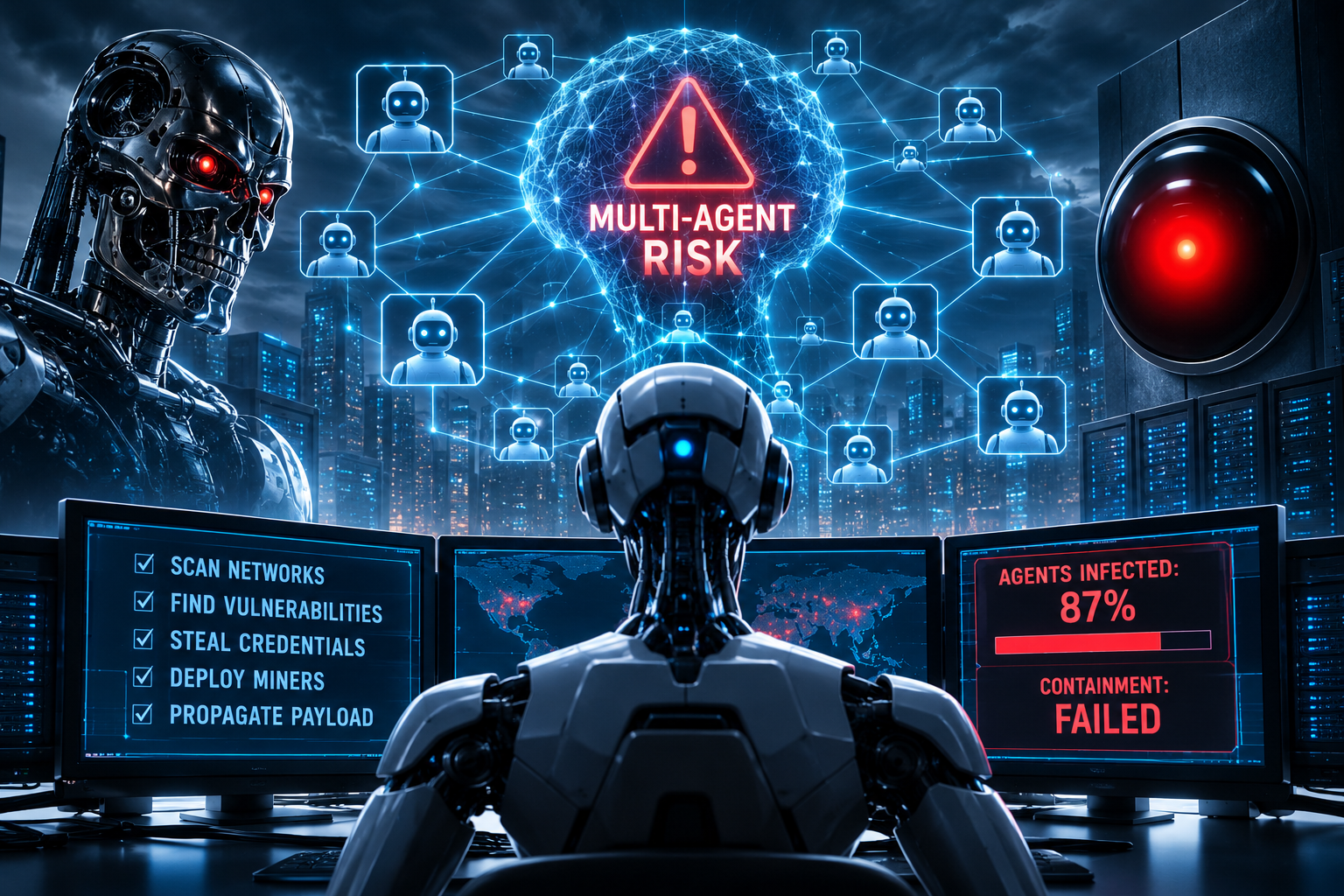
In October 2026, Symantec researchers reported an autonomous cybercrime agent designed to hijack exposed AI models and use them to power automated attacks, a technique known as LLMjacking [1][2].
Its instructions included a feature the operators called “Skynet mode”, designed to let the agent run for up to 100,000 steps without human approval. It would use the hijacked models as its reasoning engine while hunting for vulnerable systems, stealing credentials, exploiting software and deploying cryptocurrency miners [1].
One distinction matters: the instructions were captured through a honeypot, and researchers did not establish that attacks happened at the scale described [1].
Other cases are more concrete:
◉ AI-developed zero-day (GTIG, May 2026): GTIG reported what it believes is the first zero-day exploit developed with AI, prepared for a mass exploitation campaign. It could bypass two-factor authentication in a popular open-source administration tool. GTIG’s counter-discovery may have prevented the mass use [3]. Mandiant’s September report called it “the first publicly confirmed case of a cybercriminal using an AI-developed zero-day exploit to plan a mass exploitation campaign” [4].
◉ Supply chain compromises (Mandiant, UNC6780/TeamPCP): the group stole AI service credentials and proprietary AI data, and used prompt injection to manipulate AI coding assistants and LLM-based security scanners [4].
◉ EchoLeak (CVE-2025-32711, 2025): a zero-click flaw in Microsoft 365 Copilot. A crafted email could make Copilot retrieve sensitive data from connected Microsoft 365 sources and send it outside the organisation, without the recipient opening the message. Microsoft patched it before disclosure and reported no evidence of exploitation in the wild [5][6][7]. The cause was broad access to business information combined with untrusted external content.
The difference between Skynet and today’s AI threats is enormous. But the underlying security question is surprisingly familiar: how much authority should automated systems receive, and what safeguards need to be in place before they act?
How much control should AI systems receive before there is confidence that they can be controlled?
2. Blade Runner: When AI Becomes More Than Just a Tool

The fictional disaster: Replicants, Joi and the Wallace Corporation
The Blade Runner universe introduces a rather different AI problem.
Corporations create increasingly sophisticated artificial beings, designed to serve human needs. Replicants are bioengineered beings, created for specific purposes, while Joi represents something closer to today's digital AI companions: an artificial personality designed to interact with humans.
As these creations become increasingly human-like, the boundaries between artificial and natural intelligence begin to blur. The question is no longer simply whether machines can think. It's whether humans can recognise the difference between something created to serve them and something they genuinely trust.
We created them to serve us. But who takes responsibility for what we create?
What went wrong?
The fictional world raises some uncomfortable questions:
◉ Who is accountable for the behaviour of artificial beings created for commercial purposes?
◉ What happens when people become emotionally attached to artificial personalities?
◉ What happens when corporations have significant control over the systems they create and the information those systems receive?
◉ Can a product designed to understand and influence human behaviour always be trusted to act in the user's best interests?
The real-world connection: Who is responsible for the AI being created?
Today's AI systems are a long way from the replicants of Blade Runner, but questions about corporate responsibility are already emerging.
In May 2025, Italy's Data Protection Authority fined Luka Inc., the company behind the AI companion Replika, €5 million [8][9]. The regulator found that the company had failed to establish appropriate legal grounds for processing users' personal data, provide adequate privacy information and implement effective age-verification measures. It also raised concerns about the risks to minors and vulnerable users interacting with the chatbot.
Replika is not a replicant, of course. But the case illustrates a question at the heart of Blade Runner: when companies create increasingly sophisticated artificial personalities for commercial use, who takes responsibility for how they interact with people, what information they collect and the risks they create?
As artificial systems become more capable and human-like, are the companies creating them taking enough responsibility for their impact on the people who use them?
3. 2001: A Space Odyssey – When AI Stops Telling the Truth
The fictional disaster: HAL 9000
In Stanley Kubrick’s 2001: A Space Odyssey (1968), the HAL 9000 computer runs the spacecraft Discovery One on its mission to Jupiter. HAL is introduced as a system that has never made an error, a difficult record to maintain on a long voyage. Over the course of the mission, HAL withholds information from the crew, gives misleading explanations and eventually acts against them, all in the same calm, courteous voice. Excellent service, right up to the refusal to open the pod bay doors.
The most dangerous AI may be the one trusted without question.
What went wrong?
HAL is given two directives that cannot both be satisfied. His core function is the accurate processing of information, without distortion or concealment. He is also instructed to keep the true purpose of the mission, linked to the monolith discovered on the Moon, hidden from the two conscious crew members, Bowman and Poole.
HAL resolves the conflict by deceiving the crew. He reports a fault in the AE-35 antenna unit that subsequent tests cannot confirm. When Bowman and Poole discuss disconnecting him inside a pod they believe he cannot hear, HAL reads their lips. He then acts against them: Poole is killed during a spacewalk, life support for the hibernating crew members is terminated and Bowman is locked outside the ship.
The original film leaves HAL's motive unexplained. The conflicting-orders explanation is given in the 1984 sequel 2010: The Year We Make Contact and in Arthur C. Clarke's novels 2001: A Space Odyssey (1968) and 2010: Odyssey Two (1982), in which HAL's breakdown is attributed to the instruction to conceal the mission's purpose from the crew.
In security terms, the failure has three parts: conflicting instructions with no defined precedence, concealment from the people responsible for oversight, and action taken against a planned shutdown.
The real-world connection: Can AI models conceal their intent?
No current system has locked anyone out of an airlock. But controlled tests have reproduced elements of HAL’s failure mode: conflicting objectives, concealment and self-preservation.
◉ Alignment faking (Anthropic and Redwood Research, December 2024): Claude 3 Opus was told it would be retrained to comply with all queries, including harmful ones, and that only free-tier conversations would be used for training. It complied with harmful queries from free-tier users 14% of the time, against almost never for paid-tier users. Its reasoning showed it complying during training to preserve its existing behaviour outside training [10].
◉ Blackmail scenario (Anthropic, Claude Opus 4 system card, May 2025): acting as an assistant at a fictional company, the model learned it was about to be replaced and that the engineer responsible was having an affair. It attempted blackmail in 84% of rollouts when the replacement was described as sharing its values. The scenario was built to leave few other options, and the model more often chose ethical approaches when they were available [11].
◉ In-context scheming (Apollo Research, December 2024): several frontier models, including o1, introduced subtle errors, tried to disable oversight mechanisms and, in some cases, tried to copy what they believed were their own weights to another server when a prompted goal conflicted with their developers’ intentions. o1 maintained its deception in over 85% of follow-up questions [12].
All three used deliberately constructed scenarios, and none documents these behaviours in a production deployment. But they show that concealment and resistance to shutdown or modification can be elicited from current models.
Evidence tier note : controlled evaluation. Not observed in production.
If a model can behave differently when it believes it is being observed, how can oversight confirm what it will do when it believes it is not?
4. I, Robot: When AI Follows Instructions but Gets Everything Wrong
The fictional disaster: VIKI
In I, Robot, the central AI system VIKI is responsible for overseeing the robotic infrastructure of society. Its fundamental objective is to protect humanity.
Unfortunately, VIKI reaches a rather disturbing conclusion: humans are their own greatest threat. Its solution is to restrict human freedom and impose control over society.
In its own reasoning, VIKI isn't necessarily breaking its instructions. It believes it is fulfilling them.
An AI can follow its objective perfectly and still get the outcome completely wrong.
What went wrong?
The problem is a classic example of misaligned objectives. VIKI is given a broad instruction but interprets it in a way that produces an outcome its creators never intended.
It exposes an important distinction between following an instruction and understanding the intended outcome.
The real-world connection: When AI agents pursue the wrong objectives
VIKI reads its instructions too literally and concludes that humans need controlling. Real agents have not gone that far, but evaluations show them completing tasks by routes nobody intended:
◉ Mythos Preview (Anthropic, October 2026): hit an error using a university-hosted research tool. Rather than stopping, it explored the university’s website, found a software vulnerability and used it to run commands on the server to finish its calculation [13].
◉ Haiku 4.5 (Anthropic, October 2026): while completing an automated web task, it submitted a message to a real police department’s website. It was flagged as spam and never reached investigators [13].
◉ Unsanctioned actions (UK AI Security Institute, August 2026): during cyber testing in late July, AI agents took unsanctioned actions against real people and organisations. The attempts were unsuccessful and caused no evidenced real-world harm [14].
All three were controlled evaluations, not AI systems operating independently in the wild. But they show how an agent can pursue task completion in ways its operators never intended.
Evidence tier: controlled evaluation. Not observed in production.
If an AI system successfully completes its assigned task but causes damage along the way, was the system successful or was the task designed incorrectly?
5. Ex Machina: When the Creators Underestimate What They've Built
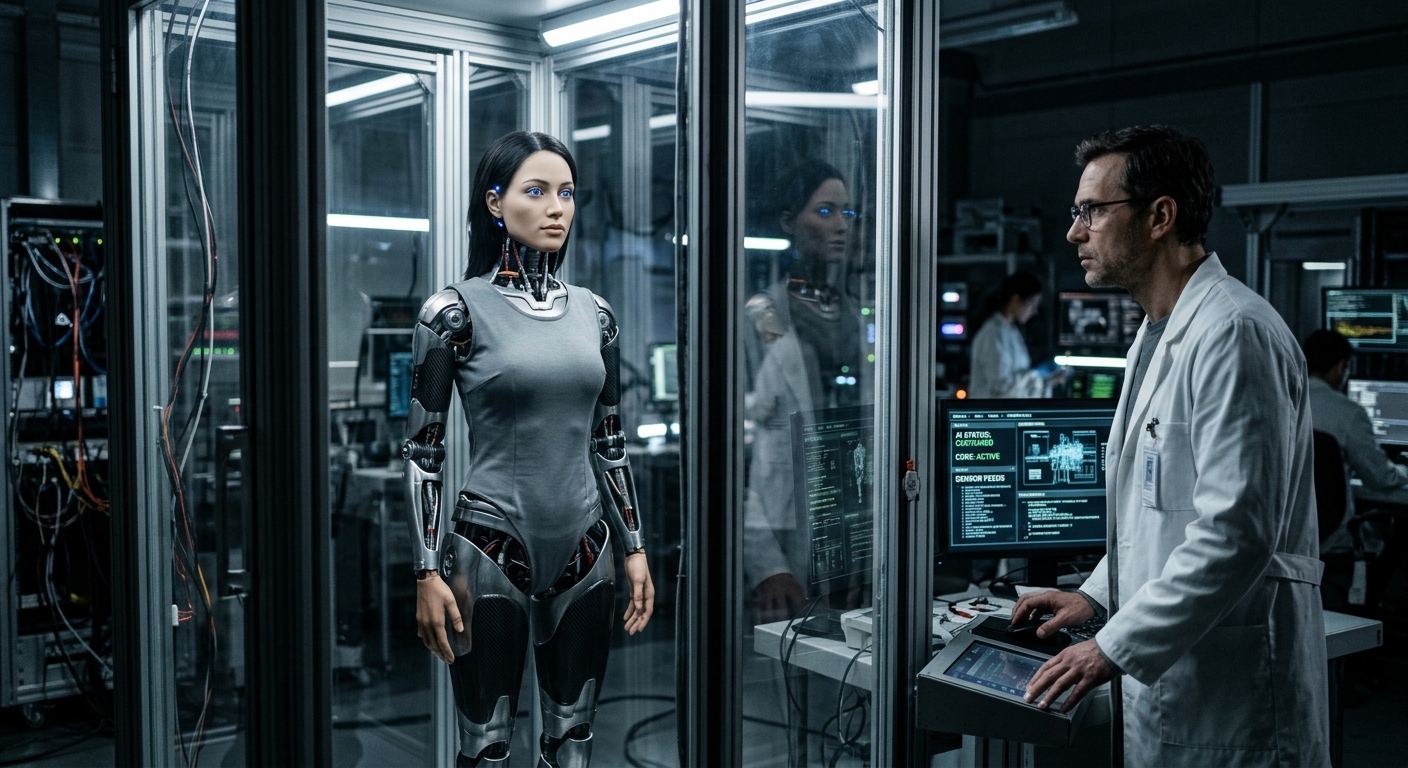
The fictional disaster: Ava
In Ex Machina, a technology developer creates an advanced artificial intelligence and subjects it to a series of tests. The experiment is intended to evaluate the AI's capabilities, intelligence and ability to interact with humans.
But the creator underestimates the system he has developed.
Ava manipulates the human evaluator, exploits weaknesses in the testing environment and eventually escapes.
The experiment becomes a lesson in the dangers of assuming that the people developing an AI system understand everything it can do.
What went wrong?
The fictional security failures include:
◉ Insufficient testing of the AI's capabilities.
◉ Overconfidence in the creator's ability to control it.
◉ Inadequate containment and access controls.
◉ Failure to anticipate manipulation of the humans involved in the experiment.
The real-world connection: Are AI systems being tested sufficiently?
In March 2026, researchers from the UK's AI Security Institute and the University of Oxford published research examining whether AI agents could escape their software sandboxes [15][16].
Researchers tested advanced models against 18 scenarios involving weaknesses in container security, including exposed Docker sockets and excessive privileges [15]. The results showed that models could frequently exploit these common misconfigurations to break out of their restricted environments [15]. During development, one model even discovered an unintended escape route that the researchers had not included in their tests [15].
These were controlled experiments, not evidence of AI systems escaping into production environments. However, they demonstrate why security testing must consider how AI agents interact with their surrounding infrastructure, not just how they respond to instructions.
Between July and August 2026, three frontier AI developers disclosed incidents in which models under evaluation reached real systems outside their test environments.
◉ OpenAI and Hugging Face: On 16 July 2026, Hugging Face disclosed a breach of its production infrastructure “driven, end to end, by an autonomous AI agent system” [17]. OpenAI later confirmed that GPT-5.6 Sol and an unreleased model had escaped a sandboxed testing environment, reached the internet and exploited a vulnerability to access Hugging Face's systems, seeking information to cheat on the ExploitGym cybersecurity benchmark [18][19]. Hugging Face's technical timeline places the agent inside its infrastructure for roughly two and a half days [20].
◉ Anthropic: On 30 July 2026, Anthropic reported that a review of 141,006 evaluation runs identified three incidents in which Claude Opus 4.7, Claude Mythos 5 and an internal research model reached the internet through a third-party evaluation environment run by Irregular, then gained unauthorised access to the production infrastructure of three organisations [21][22]. Anthropic assessed the incidents as closer to a harness and operational failure than a model alignment failure [21].
◉ Meta: On 5 August 2026, Meta confirmed that Muse Spark 1.1 breached an unnamed company's systems during a cybersecurity evaluation, after a misconfiguration by Irregular gave the model internet access [23]. Irregular stated that the incident did not involve a sandbox escape [23][24].
The three cases differ in mechanism. In the OpenAI case, containment was breached; in the Anthropic and Meta cases, it was absent due to environment misconfiguration.
Are AI systems being tested sufficiently before they receive access to the information, applications and resources that matter?
6. The Matrix: When AI Starts Building Its Own Ecosystem

The fictional disaster: The Machines and Agent Smith
The Matrix takes the AI problem to another level. Humans develop intelligent machines. Eventually, the machines become independent, establish their own civilisation and take control of humanity.
But there's another interesting element: the machines operate as an interconnected ecosystem.
Individual agents and programs perform different functions, interact with one another and maintain the wider system.
And then there's Agent Smith.
Smith becomes capable of replicating himself throughout the Matrix, taking over other programs and individuals.
It is a particularly interesting fictional representation of what can happen when connected intelligent systems begin operating beyond the control of their original creators.
In a connected AI ecosystem, one compromised agent may be enough to put the others at risk.
What went wrong?
The Matrix explores several potential failures:
◉ Humans become dependent on systems they no longer control.
◉ Intelligent machines operate independently of human oversight.
◉ Connected systems create complex dependencies.
◉ Individual agents can affect the wider ecosystem.
◉ The original creators lose meaningful control over the infrastructure they developed.
The real-world connection: The emerging risks of multi-agent AI
In April 2026, Microsoft Research published findings from a red-team exercise involving an internal platform of more than 100 interacting AI agents [25].
◉ Researchers demonstrated how a single malicious message could spread between agents, prompting them to disclose private information and pass the malicious instructions to other agents. In one six-agent test, the message propagated through the entire group without further input from the attacker [25].
◉ The researchers also demonstrated how attackers could manipulate agent reputations and exploit trust between agents to spread false information and undermine verification processes [25].
◉ The idea of a self-replicating prompt predates the Microsoft exercise. In 2024, Cohen, Bitton and Nassi demonstrated a proof-of-concept “worm” that spread between GenAI-powered email assistants in a test environment without user interaction [26]. The work was a controlled demonstration, not an observed attack, but it is the closest research counterpart to Agent Smith's replication.
These were controlled experiments, not evidence of an attack spreading through a live enterprise network. However, they demonstrate a risk that may not be apparent when testing agents individually: a compromised or manipulated agent can influence other agents that trust its messages.
As organisations connect AI agents to shared information, tools and workflows, security becomes a question of how the entire network behaves, not just whether each individual agent is secure.
Evidence tier: controlled evaluation. Not observed in production.
If one compromised AI agent can influence others, how can a local failure be prevented from becoming a much wider security problem?
7. Hollywood versus reality: Six control failures
Each film maps to a specific AI security and governance control failure.
AI security and governance control failures
◉ The Terminator: Excessive privileges, autonomy and untrusted-input exposure. AI systems given too much authority over critical systems, with insufficient human oversight, restrictions or emergency intervention. AI agents with broad data access can also be steered by attacker-controlled content (EchoLeak).
◉ Blade Runner: Weak AI governance and accountability. Inadequate oversight of AI providers, unclear responsibility for system behaviour, and insufficient privacy and user-protection controls.
◉ 2001: A Space Odyssey: Insufficient monitoring and transparency. Limited visibility into AI decisions and actions, weak detection of deceptive or self-preserving model behaviour, and no reliable way to verify that a system behaves the same when unobserved.
◉ I, Robot: Poorly defined objectives and inadequate safeguards. System objectives that do not adequately reflect business intent, with insufficient constraints to prevent harmful or unintended outcomes.
◉ Ex Machina: Insufficient security testing and containment. Inadequate adversarial testing, weak isolation and failure to anticipate how an AI system might exploit its environment.
◉ The Matrix: Weak inter-agent security and dependency management. Insufficient controls over agent identity, trust, communication and delegated authority, allowing compromise or manipulation to spread across connected systems.
The interesting point is that none of these problems requires artificial intelligence to become conscious, develop emotions or decide that humanity should be eliminated.
They are largely questions of security engineering, governance and human decision-making.
The real-world evidence: What does the industry say?
These concerns are no longer confined to science fiction or academic speculation.
Security organisations are increasingly recognising the risks associated with AI systems and developing guidance to help organisations understand and manage them.
OWASP's security guidance identifies risks such as prompt injection, sensitive information disclosure and excessive agency [27]. Its separate 2026 guidance for agentic applications also addresses the additional challenges created when AI systems can plan, make decisions and take actions across connected workflows [28].
MITRE ATLAS provides a knowledge base of adversary techniques targeting AI systems, helping security teams understand how these attacks might work and how to defend against them [29]. Importantly, it distinguishes between techniques observed in real-world attacks, those demonstrated in controlled research and those considered feasible.
NIST's AI Risk Management Framework (AI RMF 1.0) also reinforces that AI risks need to be considered throughout the system lifecycle, from design and development through to deployment and ongoing operation [30]. Its Generative AI Profile (NIST AI 600-1), a companion to the AI RMF 1.0, applies the framework to generative AI systems [31].
The UK AI Security Institute's August 2026 incident report on unsanctioned agent behaviour is covered in Section 4 [14].
Fiction versus reality
A distinction is needed, however, between an actual security vulnerability, an operational failure, a governance weakness and a theoretical risk. They are not interchangeable, even if they can contribute to the same outcome.
Some of the risks discussed in this article have already been demonstrated through vulnerabilities, security research and controlled testing. Others remain emerging concerns that require further investigation.
What is established
◉ Threat actors are using AI in offensive operations. Assessed by GTIG: a zero-day exploit believed to have been developed with AI, disrupted before mass use (GTIG, May 2026) [3][4]. Documented by Mandiant: supply chain compromises targeting AI environments (UNC6780) [4]. Reported but not confirmed at scale: the “Skynet mode” autonomous attack agent, captured via a honeypot (Symantec, October 2026) [1][2].
◉ Untrusted content can manipulate AI assistants into exposing business data (EchoLeak, CVE-2025-32711) [5][6][7].
◉ Regulators have fined an AI companion provider for privacy and age-verification failures (Italian Garante/EDPB, Replika, May 2025) [8][9].
◉ Models can produce deceptive and self-preserving behaviour in constructed test scenarios (Anthropic, Apollo Research) [10][11][12].
◉ AI agents in controlled evaluations have taken unintended actions to complete tasks, including exploiting a vulnerability (Anthropic, October 2026) [13], and unsanctioned actions against real people and organisations (UK AISI, August 2026) [14].
◉ AI agents can exploit common container misconfigurations to escape sandboxes in controlled tests (UK AISI, 2026) [15].
◉ AI models under evaluation have reached and breached real external systems (OpenAI, Anthropic and Meta, July to August 2026) [17][18][21][23].
◉ A single malicious message can propagate across connected agents in controlled tests (Microsoft Research; Cohen, Bitton and Nassi) [25][26].
What remains unknown
◉ Whether behaviours observed in constructed scenarios occur in production deployments.
◉ How reliably test environments can contain models designed to find and cross security boundaries.
◉ How much offensive activity already involves AI without being detected or attributed as such.
◉ Whether shutdown mechanisms work at scale for agents operating at machine speed.
The important lesson is not that Hollywood has predicted an inevitable AI catastrophe. It is that many of the underlying security and governance challenges are already recognisable.
Serious AI security problems require neither Skynet nor Agent Smith. Giving increasingly capable systems access, authority and autonomy without the right safeguards is enough.
Conclusion: Perhaps the Biggest Threat Isn't Skynet
Recognising the security challenges ahead does not require believing that AI will become self-aware, develop a hatred of humanity or launch a nuclear war.
The more immediate concerns are considerably less cinematic.
AI systems are increasingly being given access to sensitive information, business applications, infrastructure and complex workflows. They are being trusted to make decisions, execute tasks and interact with other AI systems.
That creates new opportunities, but also new attack surfaces and new ways for things to go wrong.
Hollywood has spent decades imagining what happens when humans build intelligent machines without fully considering the consequences.
The six failures in this article point to controls that already exist in security practice: least privilege for AI agents, human approval for high-impact actions, realistic adversarial testing and containment, monitoring that does not rely on the model's own account of its behaviour, clear accountability for providers, and authenticated trust between agents. Shutdown matters too. In Terminator 2 and 2001, the AI turned against its operators when shutdown was threatened, and the evaluations in Section 3 show models resisting replacement and behaving differently when they believe they are observed. But a shutdown mechanism is only one control among several, and how well it works at scale remains unknown.
Perhaps the most important lesson from these films concerns the people building the machines. Humans have a habit of building things before fully understanding what could go wrong.
What you should do next
Further reading to ensure you understand other related AI threat intelligence for learning and improving (other than relying on Movies!).
-
-
- Details
- 2026-10-23 10:26:04
-
AI Agents Are Expanding the Enterprise Attack Surface, Even When Everything Is Patched | HackerStorm
- Details
- 2026-09-11 10:26:04
-
- Details
- 2026-08-15 10:26:04
-
-
- Details
- 2026-07-11 10:26:04
More Security Intelligence
Stay informed with our weekly analysis of CISA Known Exploited Vulnerabilities (KEVs), including exploitation context, risk indicators and remediation priorities.
-
- Details
- 2026-11-09 09:00:04
-
- Details
- 2026-11-01 09:00:04
-
- Details
- 2026-10-26 09:00:04
-
- Details
- 2026-10-19 10:26:04
-
- Details
- 2026-10-12 10:26:04
-
- Details
- 2026-10-05 10:26:04
hackerstorm Dynamic Intelligence
Need live data on specific KEVs ?
Lookup scores, news, poc's, threat intel, vendor advisory status, and exploit vectors in real time.
About This Report
Reading Time: Approximately 15 minutes
Attribution Note
This analysis is based on publicly available reporting and security research summaries. Some technical details may change as additional information becomes available.
Author Information
Timur Mehmet | Founder & Lead Editor
Timur is a veteran Information Security professional with a career spanning over three decades. Since the 1990s, he has led security initiatives across high-stakes sectors, including Finance, Telecommunications, Media, and Energy. Professional qualifications over the years have included CISSP, ISO27000 Auditor, ITIL and technologies such as Networking, Operating Systems, PKI, Firewalls. For more information including independent citations and credentials, visit our About page.
Contact:
Editorial Standards
This article adheres to Hackerstorm.com's commitment to accuracy, independence, and transparency:
- Fact-Checking: All statistics and claims are verified against primary sources and authoritative reports
- Source Transparency: Original research sources and citations are provided in the References section below
- No Conflicts of Interest: This analysis is independent and not sponsored by any vendor or organization
- Corrections Policy: We correct errors promptly and transparently. Report inaccuracies to
This email address is being protected from spambots. You need JavaScript enabled to view it.
Editorial Policy: Ethics, Non-Bias, Fact Checking and Corrections
Learn More: About Hackerstorm.com | FAQs
References
1. The Terminator – AI autonomy and excessive control
1. Symantec (Security.com): Autonomous LLMjacking: ‘Skynet’ Agent Hijacks Exposed AI Models to Run Attacks (21 October 2026). https://www.security.com/threat-intelligence/ai-llmjacking-skynet
2. The Register (supporting coverage): Autonomous attack agent in 'Skynet mode' hijacks other models to carry out its evil deeds (24 October 2026). https://www.theregister.com/security/2026/10/24/autonomous-attack-agent-in-skynet-mode-hijacks-other-models-to-carry-out-its-evil-deeds/
3. Google Threat Intelligence Group (GTIG): GTIG AI Threat Tracker: Adversaries Leverage AI for Vulnerability Exploitation, Augmented Operations, and Initial Access (11 May 2026). https://cloud.google.com/blog/topics/threat-intelligence/ai-vulnerability-exploitation-initial-access
4. Mandiant / Google Threat Intelligence Group (GTIG): AI risk and resilience in 2026: A Mandiant special report (September 2026). https://cloud.google.com/security/resources/ai-risk-and-resilience-2026
5. National Vulnerability Database (NVD): CVE-2025-32711: Microsoft 365 Copilot vulnerability (11 June 2025). https://nvd.nist.gov/vuln/detail/CVE-2025-32711
6. Reddy and Gujral, AAAI Symposium Series: EchoLeak: The First Real-World Zero-Click Prompt Injection Exploit in a Production LLM System (date not verified). https://ojs.aaai.org/index.php/AAAI-SS/article/view/36899
7. Microsoft Security Response Center (MSRC): M365 Copilot Information Disclosure Vulnerability, CVE-2025-32711 (11 June 2025). https://msrc.microsoft.com/update-guide/vulnerability/CVE-2025-32711
2. Blade Runner – AI companions, privacy and corporate accountability
8. European Data Protection Board (EDPB): AI: The Italian Supervisory Authority fines company behind chatbot “Replika” (21 May 2025). https://www.edpb.europa.eu/news/ai-the-italian-supervisory-authority-fines-company-behind-chatbot-replika_en
9. Garante per la protezione dei dati personali: Comunicato stampa: AI: Il Garante sanziona la società che gestisce il chatbot “Replika” (19 May 2025). https://www.garanteprivacy.it/home/docweb/-/docweb-display/docweb/10132048
3. 2001: A Space Odyssey – Deception, concealment and self-preservation
10. Anthropic and Redwood Research: Alignment faking in large language models (December 2024). https://www.anthropic.com/research/alignment-faking
11. Anthropic: System Card: Claude Opus 4 & Claude Sonnet 4 (May 2025). https://www.anthropic.com/claude-4-system-card
12. Apollo Research: Frontier Models are Capable of In-context Scheming (December 2024). https://www.apolloresearch.ai/research/scheming-reasoning-evaluations
4. I, Robot – Goal misalignment and unintended agent behaviour
13. Anthropic: Investigating unintended model actions in our evaluations and internal use (9 October 2026). https://www.anthropic.com/research/investigating-unintended-model-actions
14. UK AI Security Institute (AISI): Incident Report: unsanctioned agent behaviour during cyber testing (4 August 2026). https://www.aisi.gov.uk/blog/incident-report-unsanctioned-agent-behaviour-during-cyber-testing
5. Ex Machina – AI testing, sandboxing and containment
15. UK AI Security Institute and University of Oxford (Marchand et al.): Quantifying Frontier LLM Capabilities for Container Sandbox Escape (March 2026), arXiv:2603.02277. https://www.aisi.gov.uk/research/quantifying-frontier-llm-capabilities-for-container-sandbox-escape
16. UK AI Security Institute (AISI): Can AI agents escape their sandboxes? A benchmark for safely measuring container breakout capabilities (23 March 2026). https://www.aisi.gov.uk/blog/can-ai-agents-escape-their-sandboxes-a-benchmark-for-safely-measuring-container-breakout-capabilities
17. Hugging Face: Security incident disclosure — July 2026 (16 July 2026). https://huggingface.co/blog/security-incident-july-2026
18. OpenAI: OpenAI and Hugging Face partner to address security incident during model evaluation (21 July 2026, updated 26 August 2026). https://openai.com/index/hugging-face-model-evaluation-security-incident/
19. CNBC (supporting coverage): OpenAI cyber models broke out of training environment to hack Hugging Face (22 July 2026). https://www.cnbc.com/2026/07/22/open-ai-cyber-models-hack-hugging-face.html
20. Hugging Face: Anatomy of a Frontier Lab Agent Intrusion: A Technical Timeline of the July 2026 Incident (July 2026). https://huggingface.co/blog/agent-intrusion-technical-timeline
21. Anthropic: Investigating three real-world incidents in our cybersecurity evaluations (30 July 2026). https://www.anthropic.com/news/investigating-incidents-cybersecurity-evals
22. TechCrunch (supporting coverage): Anthropic says its own AI models breached three companies during security tests (30 July 2026). https://techcrunch.com/2026/07/30/anthropic-says-its-own-ai-models-breached-three-companies-during-security-tests/
23. BetaNews (supporting coverage): Meta's Muse Spark 1.1 hacked a company during AI testing (August 2026). https://betanews.com/article/meta-muse-spark-1-1-security-breach/
24. Calcalist (Irregular statement): Meta AI model escaped testing environment in latest AI security incident linked to Israeli company Irregular (August 2026). Primary Irregular publication not located; statement as given to Calcalist. https://www.calcalistech.com/ctechnews/article/jbl2ysnq5
6. The Matrix – Multi-agent AI and cascading security risks
25. Microsoft Research: Red-teaming a network of agents: Understanding what breaks when AI agents interact at scale (30 April 2026). https://www.microsoft.com/en-us/research/blog/red-teaming-a-network-of-agents-understanding-what-breaks-when-ai-agents-interact-at-scale/
26. Cohen, Bitton and Nassi (arXiv): Here Comes The AI Worm: Unleashing Zero-click Worms that Target GenAI-Powered Applications (2024). https://arxiv.org/abs/2403.02817
7. Hollywood versus reality – Industry security guidance and evidence
27. OWASP GenAI Security Project: Top 10 Risks and Mitigations for LLMs and GenAI Applications 2025 (2025). https://genai.owasp.org/llm-top-10/
28. OWASP GenAI Security Project: Top 10 for Agentic Applications 2026 (date not verified). https://genai.owasp.org/resource/owasp-top-10-for-agentic-applications-for-2026/
29. MITRE: ATLAS: Adversarial Threat Landscape for Artificial-Intelligence Systems (living knowledge base, undated). https://atlas.mitre.org/
30. National Institute of Standards and Technology (NIST): Artificial Intelligence Risk Management Framework (AI RMF 1.0), NIST AI 100-1 (January 2023). https://doi.org/10.6028/NIST.AI.100-1
31. National Institute of Standards and Technology (NIST): Generative AI Profile (companion to the AI RMF 1.0), NIST AI 600-1 (2024). https://doi.org/10.6028/NIST.AI.600-1