
Our Blog
How Security Teams Should Operationalise the CISA KEV Catalog in 2026 | HackerStorm
Hackerstorm Threat Intelligence
The gap is not intelligence; it's decision logic. Organisations receive KEV data. Most don't have a workflow that treats it differently from everything else. This briefing provides one: a tiered decision framework, role-specific implementation guidance, and sector-adjusted operationalisation criteria.
Executive Summary
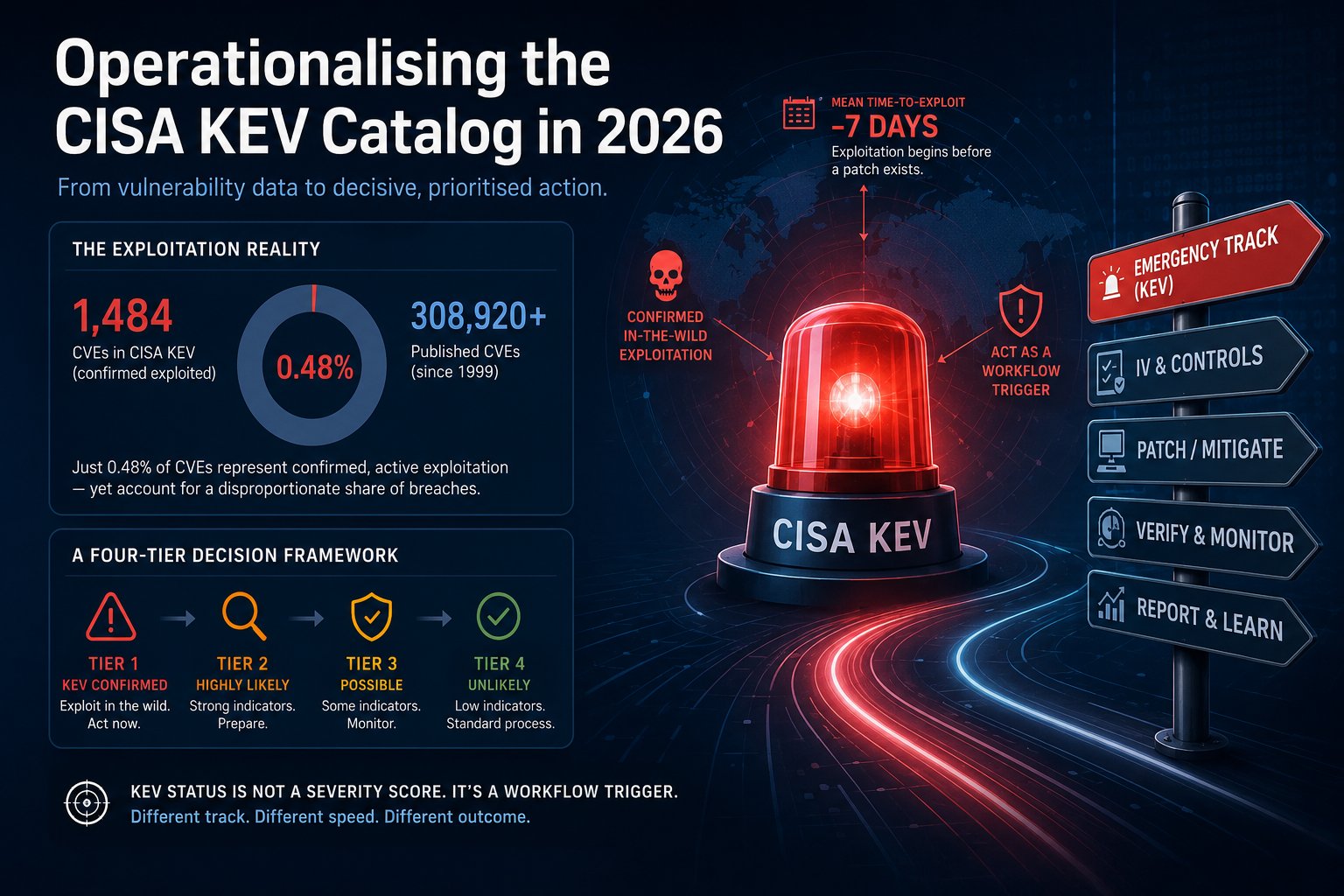
The CISA KEV catalog identifies 1,484 vulnerabilities confirmed exploited in the wild, out of 308,920+ published CVEs. That is 0.48% of all known vulnerabilities, and available evidence suggests it accounts for a disproportionate share of confirmed breaches. The operational problem is not access to this signal: most programs receive KEV data. The problem is that workflows built around CVSS scores have no structural mechanism to act on KEV status differently from any other finding. With mean time-to-exploit now estimated at -7 days, the window between catalog addition and active exploitation is, on average, already closed before a patch cycle begins. The central argument of this briefing is that KEV status must function as a workflow trigger, routing findings to a pre-defined emergency track, rather than as one severity input among many. What follows is the operational methodology to implement that distinction: a four-tier decision framework, role-specific guidance for five functions, and sector-adjusted criteria for six industries.
The Problem
This is a structural artefact, not a knowledge gap. Vulnerability management workflows were built in the 2000s and 2010s around CVSS as the only standardised severity metric available. When CISA launched KEV in November 2021, most programs had no capacity to treat it differently from existing scanner output. KEV was absorbed into workflows designed for a different signal and has stayed there.
The consequence is a category error at the point of triage. KEV status encodes confirmed, in-the-wild exploitation. CVSS encodes theoretical severity. Processing both through the same scoring formula, as most programs do, treats empirical evidence of active attack as functionally equivalent to a theoretical risk rating. The Operational Analysis section examines what that produces at the workflow level.
The Evidence
KEV represents concentrated exploitation risk. Government data from CISA and NIST's National Vulnerability Database confirms that as of end-2025, the KEV catalog contains 1,484 confirmed, actively exploited vulnerabilities out of 308,920+ CVEs published since 1999, approximately 0.48% of all known vulnerabilities. Vendor-funded research from the Cyentia Institute and Kenna Security (a VM platform vendor) found that vulnerabilities with evidence of active exploitation are 7 times more likely to affect a given organisation than those without; that figure has not been independently replicated in peer-reviewed literature but is directionally consistent with CISA's own catalog concentration data.
Time-to-exploit has gone negative. Three commercial security vendors published converging findings on exploitation speed in early 2026, each drawing on proprietary incident data. All three have a commercial interest in demonstrating the severity of the exploitation gap; the convergence across separate datasets nonetheless represents the strongest available signal on exploitation speed.
Mandiant (a Google subsidiary) released M-Trends 2026, built on 450,000+ hours of paid incident response engagements, estimating mean time-to-exploit at -7 days for 2025. Exploitation begins, on average, before a vendor patch is publicly available. Rapid7 found the median window between vulnerability publication and CISA KEV addition compressed from 8.5 days to 5 days. CrowdStrike found 42% of exploited vulnerabilities were attacked before public disclosure.
Organisations running monthly patch cycles alone are unlikely to be operating ahead of this timeline.
CVSS alone is a poor predictor of exploitation. Independent nonprofit research from FIRST.org's EPSS project, the most methodologically transparent public dataset on exploitation probability, found that only approximately 2.3% of CVEs scored 7.0 or higher are observed in actual exploitation attempts within any given measurement period.
The misalignment runs in both directions. Some KEV-listed vulnerabilities carry CVSS scores below 7.0 but appear in active ransomware and nation-state operations. Conversely, a CVSS 9.8 rating with no public exploit code and no known threat actor interest carries less urgency than a CVSS 6.5 entry confirmed in the wild.
Fewer than 5% of all published CVEs are ever observed exploited. KEV membership is a sharper filter than any severity score.
Federal mandates have set a response baseline that private sector timelines often don't meet. CISA's Binding Operational Directive 22-01 (2021) originally required Federal Civilian Executive Branch agencies to remediate KEV vulnerabilities within 14 days of catalog addition. On June 10, 2026, CISA issued BOD 26-04, which revokes BOD 22-01 and replaces the flat 14-day window with a four-variable risk model — asset exposure, KEV status, exploit automation, and technical impact — that assigns remediation windows ranging from 3 days (highest-risk combinations, with mandatory forensic triage) to deferral until the next scheduled system upgrade. Private sector organisations face no equivalent mandate, but face the same threat actors. The gap between federal response timelines and typical enterprise patch cycles creates an asymmetry that available evidence suggests adversaries exploit systematically.
Exploitation volume is accelerating faster than remediation capacity. Rapid7's 2026 Global Threat Landscape Report, vendor research based on Rapid7's own MDR incident data, found confirmed exploitation of newly disclosed high-severity vulnerabilities (CVSS 7-10) increased 105% year-over-year, from 71 cases in 2024 to 146 in 2025. As a vendor with commercial interest in demonstrating threat severity, this figure should be read alongside government and academic sources; it is directionally consistent with CISA's catalog growth data and Mandiant's findings.
Operational Analysis
Enterprise vulnerability queues are not manageable at CVSS-first scale. Practitioner experience indicates a typical enterprise generates 50,000-200,000 findings per month, a range that varies by organisation size and scanning coverage, but one where 15-20% are flagged critical or high by CVSS. That volume consistently exceeds available remediation capacity. Programs that treat all high-severity findings as equivalent lose KEV signal in the noise.
In most programs, the queue does not clear. Patching one round of vulnerabilities surfaces the next. Teams tend to optimise for volume reduction, closing the most tickets rather than addressing the highest-probability threats. That dynamic is what makes the decision logic problem structural rather than behavioural.
When a new KEV entry arrives, multiple industry reports and practitioner accounts indicate many programs have no automatic interrupt. The entry joins the standard ticket queue and waits for the next weekly triage meeting.
The timeline from KEV addition to patch deployment, without a pre-defined emergency track, frequently exceeds two weeks. Against a mean time-to-exploit of -7 days, that gap cannot be closed through faster process execution alone. The process itself needs to change.
Vulnerability management platforms advertise "risk-based prioritisation" and "threat intelligence integration." In practice, practitioner experience indicates many implementations add KEV as one more input in a scoring formula without changing how findings move through the workflow. The output looks different. The process is identical. Ticket volume, not exploitation probability, remains the optimisation target.
The fix is not a platform upgrade. Practitioner accounts describe organisations that replaced their VM tooling without redesigning triage policy and reported the same KEV handling failures on new infrastructure. The constraint is policy: the absence of a clear, documented definition of what a KEV designation triggers and who is authorised to act on it without a standard approval cycle. The Decision Framework section provides that definition.
Visibility Gaps and Control Failures
Many vulnerability scanners cross-reference NVD but not KEV status natively. Where KEV tagging requires manual correlation or TI platform integration, a lag develops between CISA catalog addition and organizational recognition of immediate priority.
Practitioner estimates place the resulting exposure lag at 7-14 days: the time teams spend waiting for tools to surface KEV status or manually cross-referencing data sources. Controlled measurement of this lag across programs is limited; the figure represents the range most commonly reported.
Asset inventory gaps compound the lag. Organisations identify a CVE as KEV-listed but cannot determine which assets are affected without accurate CMDB data. Unresolved asset attribution defaults the finding to standard scheduling rather than emergency track.
Change governance creates a third delay vector. CAB approval cycles designed for scheduled maintenance windows are incompatible with 72-hour Tier 1 SLAs. Without a pre-negotiated emergency change track, KEV findings queue for the next monthly window by default.
EPSS integration gap: Most VM consoles do not surface EPSS scores natively. Manual export-enrich-reimport cycles running weekly at best introduce data latency that undermines Tier 4 escalation logic. Daily EPSS refresh is the minimum operational requirement.
Decision Framework
KEV status is the primary triage criterion. CVSS, EPSS, asset exposure, and asset criticality operate as secondary inputs within each tier. A vulnerability is assigned to the highest applicable tier - lower-tier criteria do not accumulate to override a higher-tier classification.
Priority Tier Table
| Tier | KEV Status | EPSS Score | Asset Exposure | Asset Criticality | Remediation Window | Change Process | Compensating Control Required |
| Tier 1 → Immediate Response | Listed | Any | Internet-facing | Any | 72 hours | Pre-approved emergency track | Yes (deploy in parallel with patch) |
| Tier 2 → Accelerated Response | Listed | Any | Internal | High (revenue, sensitive data, critical infrastructure) | 7 days | Expedited CAB | Conditional (if patch is unavailable within 48 hours) |
| Tier 3 → Standard Priority | Listed | Any | Internal | Low–Medium | 14 days (aligned with CISA BOD 26-04) | Standard scheduled window | No (unless EPSS > 0.50) |
| Tier 4 → Risk-Based Queue | Not listed | Variable | Any | Any | Based on CVSS + EPSS composite score | Standard scheduled window | No |
Input Signal Definitions
KEV Status: Binary - CVE present in CISA KEV catalog, yes or no. Checked at scanner ingestion, not at triage review.
EPSS Score: Probability of exploitation in next 30 days, expressed as 0.00–1.00. Threshold for Tier 4 escalation: ≥ 0.50.
Asset Exposure: Internet-facing (publicly routable), Internal (behind perimeter), or Isolated (air-gapped or segmented). Sourced from asset inventory; assets without a classification default to Internet-facing.
Asset Criticality: High (revenue systems, personal data repositories, OT/ICS, authentication infrastructure), Medium (business support systems), Low (development, test, isolated workstations).
Escalation Criteria
The framework dynamically adjusts urgency, elevating a vulnerability to a higher-priority track the moment real-world threat intelligence or environmental data invalidates the baseline assumptions of its current tier.
| Current Track | Target Track | Mandatory Escalation Trigger Condition |
| Tier 4 | Tier 3 |
• CVE officially added to CISA KEV catalog (immediate re-tier) • EPSS score crosses the $\ge 0.50$ threshold • Exploitation reported in ISAC sharing channels without formal KEV addition |
| Tier 3 | Tier 2 |
• Threat intelligence reports active exploitation in sector-specific campaigns within 7 days • EPSS score increases $\ge 0.20$ within a 72-hour window • Asset reclassified from Medium to High criticality • New public proof-of-concept (PoC) published post-KEV addition |
| Tier 2 | Tier 1 |
• Confirmed exploitation detected in your environment or peer organization (ISAC reporting) • Threat actor attribution to an APT group with active targeting of your sector • Asset exposure reclassified from Internal to Internet-facing • Patch is unavailable and compensating controls are insufficient to block the attack vector |
No-Patch Escalation Path
Patch unavailable at time of KEV addition: Deploy compensating controls within Tier SLA window → Document control coverage gap → Initiate vendor contact for patch timeline → Review asset isolation feasibility → Escalate to accepted risk register if no viable mitigation exists → Monitor for exploitation indicators every 24 hours until patch available.
Framework Constraints
Asset inventory dependency: Tier 1 and Tier 2 classifications require accurate Internet-facing and criticality tagging in CMDB. Unclassified assets default to Tier 1 treatment. CMDB accuracy below 80% degrades framework precision proportionally.
Change management dependency: Tier 1 remediation windows (72 hours) require a pre-negotiated emergency change track with standing CAB approval. Organisations without this track in place must negotiate it before framework adoption. Runtime negotiation during active exploitation is a documented failure mode.
EPSS data latency: EPSS scores update daily. Scanner integrations pulling EPSS weekly introduce a data lag that reduces escalation trigger accuracy. Daily EPSS refresh is the minimum operational requirement for Tier 4 escalation logic to function correctly.
Operational Outcomes
Cost of misaligned prioritization. Peer-reviewed research supports the underlying problem, if not the specific figures sometimes quoted for it. Jacobs et al., "Improving Vulnerability Remediation Through Better Exploit Prediction" (Journal of Cybersecurity, 2020), found that a CVSS-only strategy of remediating all vulnerabilities scored 7.0 or higher achieves only about 9% efficiency — meaning the vast majority of remediation effort under that strategy goes toward vulnerabilities with no observed exploitation. Controlled research isolating KEV-first triage specifically, rather than exploit-prediction models generally, as the sole variable remains limited.
Remediation queue reduction. Practitioner experience, not controlled research, indicates that deprioritising non-KEV findings with low EPSS scores can reduce active queue volume by 40-60%, with outcomes varying by program maturity and initial CVSS dependency. Independent nonprofit data from FIRST.org's EPSS project shows that an EPSS threshold of 10% reduces the remediation population to a small fraction of CVSS-flagged findings while retaining meaningful exploitation risk coverage.
Reduction in time-to-patch for high-risk vulnerabilities. Practitioner accounts, not peer-reviewed study results, describe reductions in median time-to-patch for actively exploited vulnerabilities from 30-45 days to 7-14 days following KEV-first triage adoption. No controlled study isolates this effect exclusively; these figures represent self-reported operational outcomes. The mechanism is structurally sound: KEV status triggers a pre-defined workflow instead of requiring risk assessment and prioritisation debate, removing decision friction from the critical path.
Governance visibility and audit defensibility. KEV-first operationalisation produces a measurable improvement in reporting precision that CVSS-based programs cannot replicate. When KEV entries are tracked on a separate SLA track, executive dashboards can surface mean time-to-patch specifically for confirmed-exploitation findings, rather than averaging them into the broader remediation population. Practitioner accounts indicate this separation makes SLA compliance visible at the tier level: Tier 1 (72 hours), Tier 2 (7 days), and Tier 3 (14 days) each carry a discrete compliance rate rather than a single aggregate metric.
For audit and regulatory purposes, a documented record of KEV triage decisions, covering timestamp of catalog addition, tier assigned, patch or compensating control deployed, and SLA met or escalated, constitutes the evidence trail that regulators, cyber insurers, and IR teams increasingly request.
Organizations subject to NY DFS 23 NYCRR 500, HIPAA breach response requirements, or SEC incident disclosure rules benefit from the same record: a defensible, timestamped account of how each confirmed-exploitation finding was handled. Board reporting improves correspondingly. Rather than presenting aggregate patch rates, security leaders can report against the population that carries actual breach risk: KEV entries on Internet-facing and high-criticality assets. That framing aligns security metrics with business risk in terms a board can evaluate.
Workflow Integration Guidance
Vulnerability Management Engineer
Primary responsibility: KEV status check at scanner ingestion, not at triage review.
→ Auto-tag findings with KEV status and EPSS score at ingestion via daily API sync. Any finding where KEV = true AND asset_exposure = internet-facing routes directly to Tier 1, bypassing standard triage.
→ Enforce three required attributes on every finding: KEV status, exposure classification, criticality tier. Missing attributes default to highest-risk classification.
→ Run a daily KEV delta report: new catalog additions cross-referenced against active asset inventory, distributed to the VM team and TI analyst each morning.
Metric: Mean time from KEV addition to Tier 1 ticket creation. Target: < 4 hours.
Threat Intelligence Analyst
Primary responsibility: Enrich KEV entries with threat actor context and generate escalation signals.
→ For each new KEV entry: document threat actor associations (APT designations, ransomware affiliations), exploit maturity (PoC / weaponized / commodity), and days from disclosure to catalog addition.
→ Push escalation signals to VM Engineer on: confirmed APT attribution with sector targeting, EPSS delta ≥ 0.20 within 72 hours, or ISAC-reported exploitation ahead of formal catalog addition.
→ Maintain a sector-specific KEV watch list reviewed weekly. ISAC-reported exploitation without formal catalog addition triggers Tier 4 → Tier 3 escalation.
Metric: Threat actor attribution coverage for active KEV entries. Target: ≥ 70% of entries relevant to the organisation's asset profile.
Detection Engineer
Primary responsibility: Deploy detection coverage in parallel with patch, not after.
→ Open a detection ticket at the same time the patch ticket is created for every Tier 1 and Tier 2 entry. Query SIEM and EDR rule sets within 24 hours. Gaps on Tier 1 require immediate rule development or vendor signature pull.
→ Maintain a KEV detection coverage matrix: CVE identifier, ATT&CK mapping, detection source, coverage status, date achieved.
→ Run retrospective hunts against 30-day log data for each new Tier 1 entry. Exploitation may predate the catalog addition. Escalate anomalies to IR.
Metric: Detection coverage rate for Tier 1 and Tier 2 entries. Target: 100% coverage within 48 hours of Tier 1 ticket creation.
Security Manager
Primary responsibility: Pre-negotiate the organizational conditions that make the framework executable.
→ Secure a standing pre-approved emergency change track with CAB before rollout. Activation conditions: KEV = true AND asset_exposure = internet-facing. Standing policy, not runtime authorization.
→ Get KEV SLA policy signed by CISO and CIO: Tier 1 = 72 hours, Tier 2 = 7 days, Tier 3 = 14 days. Define the accepted-risk path for no-patch scenarios before it is needed.
→ Report to leadership monthly: Tier 1 mean time-to-patch, detection coverage rate, escalation frequency by tier, accepted risk register size. Quarterly review against 90-day performance data.
Metric: SLA compliance rate. Target: ≥ 95% of Tier 1 findings remediated or compensating controls deployed within 72 hours.
IT Operations / Patch Engineer
Primary responsibility: Execute KEV patches on a separate track from the standard monthly cycle.
→ Maintain a KEV patch runbook separate from the standard cycle: emergency change template, reduced testing threshold for Tier 1 (functional validation plus rollback readiness), and rescan trigger on completion.
→ Pre-configure deployment groups for internet-facing, critical infrastructure, and authentication assets so Tier 1 patches deploy without manual asset selection.
→ Verify every Tier 1 patch via authenticated rescan within 4 hours. A failed patch with no compensating control triggers IR notification; it does not re-enter the standard queue.
Metric: Patch verification rate for Tier 1 findings. Target: 100% confirmed via authenticated rescan within 4 hours of deployment.
Industry Context
Sector Variables Matrix
| Industry Sector | Primary Operational Constraint | Local Framework Adjustment | Recommended ISAC |
| Financial Services | PCI DSS scope amplifies KEV blast radius on payment infrastructure; NY DFS 23 NYCRR 500 requires documented remediation timelines. |
• Tier 2 compresses to 5 days for PCI-scope assets. • Accepted risk on any KEV entry requires CISO sign-off. |
FS-ISAC |
| Healthcare | Legacy medical device OS and EHR infrastructure with no available patch path from vendor makes the no-patch escalation path the norm. |
• Compensating controls (segmentation, monitoring) substitute for patches in Tier 1. • Device isolation feasibility review mandatory within 24 hours of Tier 1 addition. |
H-ISAC |
| Critical Infrastructure - Energy | NERC CIP-007-6 patch windows (35 days for medium-impact OT systems) conflict directly with Tier 1 SLAs. |
• OT assets classified High criticality by default. • Tier 1 OT SLA = compensating control within 72 hours; patch deferred to next vendor maintenance window. • IT/OT boundary devices treated as Internet-facing. |
E-ISAC |
| Federal / Government | BOD 26-04 (effective June 10, 2026) is mandatory for FCEB and FedRAMP; SLTT faces identical threats without a mandate. |
• Tier 1 (72 hours) and Tier 3 (14 days) map directly onto BOD 26-04 compliance windows. • Agencies must cross-verify exact mappings against the directive's four-variable risk matrix. |
MS-ISAC (SLTT) |
| Technology / SaaS | Multi-tenant environments amplify blast radius; third-party and open-source dependencies carry hidden KEV exposure. |
• Tier 1 tightens to 48 hours for multi-tenant production infrastructure. • Dependency KEV tracking required alongside traditional asset scanning. |
IT-ISAC |
| Manufacturing / Industrial | Critical production downtime risks make patch-first sequencing fundamentally impractical for floor assets. |
• Compensating controls completely replace patch-first approach for floor assets. • OT/IT boundary devices receive automatic Tier 1 classification regardless of exposure rating. |
MFG-ISAC |
Cross-Sector Constants
KEV addition rate: Catalog additions have increased year-over-year since November 2021. Sector adjustments change response capacity, not the underlying signal volume.
Threat actor convergence: Nation-state TTPs appear in ransomware toolkits. Multiple vendor threat reports show commodity exploit code reaching KEV-listed CVEs within hours to days of PoC publication, a finding consistent across Mandiant, Rapid7, and CrowdStrike reporting, though each draws on proprietary telemetry. Sector threat actor profiles inform sequencing, not tier logic.
CMDB accuracy: Asset inventory quality determines framework precision in every sector. Assess CMDB coverage before calibrating sector-specific SLA targets.
Further Reading
🔗 Vulnerability Management: Operational Risk & Exposure-Based Prioritization
Why read this: This article provides the comprehensive operational framework for implementing exposure-based vulnerability prioritisation at enterprise scale. While the current article demonstrates why CVSS-only models fail and presents the efficiency case for integration, this resource delivers the complete implementation methodology: covering risk modelling, asset classification, exposure mapping, and organisational workflow redesign needed to operationalise EPSS + KEV + reachability decisioning across security teams.
🔗 Why Most Patch Programs Fail: CVSS Overload, KEV Lag, and Exposure Blind Spots
Why read this: Most vulnerability programs fail not due to lack of effort, but flawed prioritization logic. This article breaks down how CVSS inflation, delayed KEV response, and lack of exposure context create systemic blind spots and what to change to align patching with real-world exploitation risk.
🔗 Operational Threat Intelligence: Practical Guide for Security Teams
Why read this: Prioritization requires context. This guide explains how to integrate threat intelligence into security operations helping teams move from reactive patching to intelligence-driven decision making.
🔗 CISA KEV Weekly Intelligence Reports
Why read this: The primary source for catalog additions and removal notices; essential for teams automating KEV ingestion to monitor for additions, updates, and the occasional removal that can affect tier assignments.
🔗 FIRST 2026 Forecast: Record-Breaking 59,000 CVEs Signal "Strategic Shift" for Security Teams (projected)
Why read this: Vulnerability volume is accelerating beyond human-scale prioritization. This analysis explains why record CVE growth forces a shift toward EPSS, KEV, and exposure-based models and how security teams must adapt to avoid being overwhelmed by noise.
🔗 MOVEit Mass Exploitation (OFA): KEV Prioritization and Internet-Facing Asset Visibility Failure
Why read this: This analysis shows how a widely exploited vulnerability escalated into a global breach despite clear signals, KEV prioritization, and available patches: highlighting where vulnerability management and asset visibility break down under real-world attack conditions.
🔗 CVSS vs EPSS: How to Prioritise Vulnerabilities by Real Exploitation Risk
Why read this: CVSS measures theoretical severity, but EPSS predicts real-world exploitation probability. Learn why modern vulnerability management must combine both to prioritise the risks attackers actually target.
Hackerstorm Analysis
The programs best positioned to act on KEV in 2026 are not necessarily the ones with the most mature tooling. They are the ones that resolved a governance question first: who has standing authorisation to break the normal change process when KEV = true and the asset is Internet-facing? Programs that cannot answer that question in under 30 seconds have not operationalised KEV; they have enriched their queue.
There is a compounding debt problem that the operational metrics in this briefing do not fully capture. Every KEV entry that transits a standard 30-day patch cycle rather than a 72-hour emergency track represents a measurement failure as much as a response failure. Most organisations track mean time-to-patch. Fewer track mean time-to-patch specifically for KEV entries, separated from the broader population. Without that separation, programs cannot see whether KEV-first triage is working and cannot demonstrate to leadership or auditors that it is.
The measurement gap has a second-order effect: it makes the program invisible to its own governance. A CISO reviewing a dashboard showing median time-to-patch of 18 days may not realise that three Tier 1 KEV entries were included in that average and skewed it downward, or that two others were not patched within SLA and were absorbed into the mean without triggering escalation. KEV-first triage requires KEV-specific reporting. The same aggregated metrics that worked for CVSS-based programs obscure exactly what a KEV-aware program needs to surface.
The strategic implication is this: the organisations that will have defensible vulnerability programs in three years are not the ones patching the most CVEs. They are the ones that can prove, to an auditor, a regulator, or an IR team, that every KEV entry was triaged within hours of catalog addition, routed by policy rather than judgment, and closed or escalated with a documented rationale. That is a governance and measurement problem, not a tooling problem. And it is solvable before the next KEV entry lands.
About This Report
Attribution Note
This analysis is based on publicly available reporting and security research summaries. Some technical details may change as additional information becomes available.
Author Information
Timur Mehmet | Founder & Lead Editor
Timur is a veteran Information Security professional with a career spanning over three decades. Since the 1990s, he has led security initiatives across high-stakes sectors, including Finance, Telecommunications, Media, and Energy. Professional qualifications over the years have included CISSP, ISO27000 Auditor, ITIL and technologies such as Networking, Operating Systems, PKI, Firewalls. For more information including independent citations and credentials, visit our About page.
Contact:
Editorial Standards
This article adheres to Hackerstorm.com's commitment to accuracy, independence, and transparency:
- Fact-Checking: All statistics and claims are verified against primary sources and authoritative reports
- Source Transparency: Original research sources and citations are provided in the References section below
- No Conflicts of Interest: This analysis is independent and not sponsored by any vendor or organization
- Corrections Policy: We correct errors promptly and transparently. Report inaccuracies to
This email address is being protected from spambots. You need JavaScript enabled to view it.
Editorial Policy: Ethics, Non-Bias, Fact Checking and Corrections
Learn More: About Hackerstorm.com | FAQs
Source Transparency
Government Publications
→ CISA Known Exploited Vulnerabilities Catalog — primary catalog data and addition rate figures: cisa.gov/known-exploited-vulnerabilities-catalog
→ CISA Binding Operational Directive 26-04 — "Prioritizing Security Updates Based on Risk" (effective June 10, 2026; supersedes and revokes BOD 22-01 and BOD 19-02); four-variable remediation model with windows from 3 days to next-upgrade deferral: cisa.gov/news-events/directives/bod-26-04-prioritizing-security-updates-based-risk
→ CISA Binding Operational Directive 22-01 (2021–2026, superseded) — cited for historical context only; established the original 14-day KEV remediation baseline for FCEB agencies, revoked by BOD 26-04: cisa.gov/bod-22-01
→ National Vulnerability Database (NIST) — cumulative CVE count (308,920+ as of end-2025): nvd.nist.gov
Academic and Independent Research
→ Jacobs, J., Romanosky, S., Adjerid, I., and Baker, W., "Improving Vulnerability Remediation Through Better Exploit Prediction," Journal of Cybersecurity, Vol. 6, No. 1 (2020), tyaa015 — peer-reviewed. Cited for: efficiency/coverage figures for CVSS-only (scored 7.0 or higher) remediation strategies.
→ FIRST.org EPSS Project — independent nonprofit. Model documentation, daily scoring data, and exploitation probability methodology: first.org/epss. Cited for: 2.3% exploitation rate among CVSS 7+ CVEs.
Industry Research
Note: all sources in this category are vendor-produced. Each organisation has a commercial interest in demonstrating threat severity. Findings are cited where they converge across multiple independent datasets or are consistent with government data.
→ Mandiant (Google subsidiary, paid IR services) — M-Trends 2026, based on 450,000+ hours of incident response engagements. Cited for: mean time-to-exploit -7 days (2025 estimate): mandiant.com/m-trends
→ Rapid7 (VM and detection vendor) — 2026 Global Threat Landscape Report, based on proprietary MDR data. Cited for: median time from vulnerability publication to KEV addition compressed to 5 days; confirmed CVSS 7–10 exploitation up 105% year-over-year (71 to 146 cases): rapid7.com/research
→ CrowdStrike (EDR and threat intelligence vendor) — 2026 Global Threat Report. Cited for: 42% of exploited vulnerabilities attacked before public disclosure.
→ Cyentia Institute and Kenna Security (VM platform vendor) — "Prioritization to Prediction Volume 6." Cited for: 7x exploitation likelihood for vulnerabilities with confirmed exploitation evidence. Not independently replicated in peer-reviewed literature; directionally consistent with CISA catalog concentration data.
→ Orca Security (cloud security vendor) — EPSS analysis. Cited for: supporting data on EPSS exploitation rates: orca.security/epss
→ Verizon Data Breach Investigations Report (DBIR) — industry consortium report drawing on contributed breach data from participating organisations. Not independent research. Cited for breach attribution trends; methodology varies year-over-year.
→ Indusface (WAF and security vendor) — EPSS scoring guide (2026). Cited for supplementary EPSS context: indusface.com/epss
News and Analysis
Used for secondary corroboration of government data only. Not cited as primary evidence.
→ Cyble, "2025 CISA KEV Catalog Hits 1,484 Exploited Vulnerabilities" (January 2026): cyble.com
→ SecurityWeek, "CISA KEV Catalog Expanded 20% in 2025, Topping 1,480 Entries" (January 2026): securityweek.com
→ Stingrai, "Vulnerability Statistics 2026: CVE, KEV, Time to Exploit" — secondary aggregation citing JerryGamblin cumulative CVE count (end-2025): stingrai.io