
Beyond CVEs: Managing Operational Vulnerabilities | Lessons from the Snowflake Breach
- Details
- 2026-10-26 10:26:04
Subscribe and get these articles emailed when published
HackerStorm Ref: OFA-2026-10-BNC
On 29 October 2026, unauthorised withdrawals totalling approximately $6.36 billion (per TRM Labs) were executed across 10 blockchain networks, with Binance confirming the incident in official statements on 30 October 2026. This analysis strips out the headline framing and examines the incident as a control system failure, mapped layer by layer to allow you to consider whether the same attack path and vulnerabilities exists in your organisation.
Status Note: Developing incident. Loss totals, frozen asset figures, timeline markers, and attribution reflect Binance statements and on-chain tracing (TRM Labs, Chainalysis, Blockaid) as of 30 October 2026, and remain subject to revision as investigations and asset recovery efforts continue.
Tag key: [Confirmed] = stated by Binance; [Reported] = stated by a named third party (e.g., TRM, Chainalysis, Blockaid, Arkham); [Inferred] = our analysis.
Organisation: Binance. [Confirmed]
Confirmed impact: Approximately $6.3 billion in unauthorised withdrawals across 10 chains (per Binance and TRM Labs) [one secondary source reports 9 chains; see Open Questions]. Binance reports approximately $3 billion frozen on-chain with blockchain partners and stablecoin issuers, including Tether and Circle. [Confirmed]
Loss figures: Binance ~$6.3B [Confirmed]; TRM Labs $6.36B [Reported]; Chainalysis ~$5.9B at time of theft [Reported]; Arkham Intelligence early estimate >$5.8B [Reported]. Figures differ by methodology and timing. Frozen: Binance says ~$3B. [Confirmed]
Initial entry point (preliminary, per Binance): Binance states its initial investigation “suggests” the incident “may involve” a compromised DevOps engineer's laptop, the initial entry point of a multi-stage compromise, per the Binance official statement of 30 October 2026 (ABC News). [Confirmed]
Attack duration: Drain activity 20:04 to 23:56 UTC on 29 October, with the main drain concentrated in an initial 20-minute window; EIP-7702 delegation cancelled 00:10 UTC on 30 October (Bitquery, secondary source; pending primary confirmation). [Reported]
Service status: Binance suspended deposits and withdrawals. [Confirmed]
Exploited mechanism: Misuse of hot wallet signing infrastructure via bundled EIP-7702 authorisations on Ethereum, alongside authorised API container access for the other 9 chains. [Reported] Binance reports no evidence of any wallet private key leak [Confirmed]; Blockaid's preliminary assessment is key misuse (manipulation of the signing system) rather than key theft [Reported]. Abuse occurred directly inside the signing path of hot wallet “Binance 14”. [Reported]
Attribution: Blockchain intelligence firms (TRM Labs, Chainalysis) attribute the operation with high confidence to North Korea's TraderTraitor cluster, linked to the Lazarus Group [Reported]; Binance has noted it is assisting active law enforcement investigations without naming an actor. [Confirmed]
Media coverage: Sky News reported Arkham Intelligence figures (early estimates) of more than $5.8bn taken from Binance and more than $2.3bn frozen, alongside founder Changpeng Zhao's statement on X that “it does look like a hack” (Sky News). CNBC reports a potential North Korean state-sponsored link based on TRM Labs and Chainalysis attribution (CNBC). [Reported]
Operational Relevance Statement: This incident highlights a failure in Identity Governance and Segmentation, compounded by absent invariant controls on the transaction authorisation path. [Inferred]
Lookup scores, news, poc's, threat intel, vendor advisory status, and exploit vectors in real time.
The defender's clock matters more than the attacker's. Here is the signal sequence available before and during the breach.
Pre-incident: Operator address funded via Tornado Cash and linked to the sweep contract. Detection opportunity: High-risk counterparty interaction (mixer-funded relayer) initiating contract deployments in proximity to monitored exchange EOAs.
Pre-incident: DevOps engineer endpoint compromised. Detection opportunity: EDR telemetry, device posture drift, anomalous credential use from a developer host, service-to-service authentication anomalies from newly accessed backend hosts.
T-0 (20:20:59 UTC, 29 October, per Blockaid): Attacker submits 50 EIP-7702 authorisations, signed in advance via the compromised signing path, in a single Ethereum transaction targeting “Binance 14”, alongside anomalous API calls on the other 9 chains. Only one authorisation succeeded: the one matching the account nonce. The 50-authorisation batch functions as a nonce-guessing tactic and is itself a detection signal. [Reported] Detection opportunity: any delegation of a treasury wallet to an unverified contract is a high-severity invariant violation; signing-proxy policy violation (signing raw EIP-7702 tuples without an allowlisted target); a single transaction carrying multiple authorisations for the same account across consecutive nonces; batch-transaction structure anomalies (e.g., non-standard gas/fee parameters).
T+0 to T+20: Mass sweeping occurs across 10 chains concurrently. A single Ethereum delegation call sweeps $2.5 billion, per TRM Labs. [Reported] Detection opportunity: velocity anomaly at the gateway level. No public evidence of an internal circuit breaker activating [Inferred].
20:04 to 23:56 UTC, 29 October (drain activity); 00:10 UTC, 30 October (delegation cancelled): The sweep contract remains active and is invoked 7 times. [Reported: Bitquery, secondary source; pending primary confirmation] Detection opportunity: State-diff monitoring (flagging any hot wallet account where code is non-empty, i.e., EIP-7702 delegation designator 0xef0100 present). A 7702 delegation can only be reset by a new signed authorisation from the account key, or by moving funds. With the signing path compromised, the control is to cut the signing infrastructure and move funds to clean wallets.
T+40m onward: Tether, Circle, and partner security councils execute freezes; Binance reports approximately $3 billion frozen on-chain. [Confirmed] The circuit breaker function executes externally, outside Binance infrastructure. [Inferred]
Initial Access: Compromise of a DevOps engineer's laptop (initial entry point; Binance management noted the attack leveraged broader multi-stage container access beyond a single user's permissions). [Confirmed] Entry method on the endpoint remains unattributed publicly.
Persistence: Based on reporting, attackers appear to have maintained access long enough to stage infrastructure, including advance deployment of the sweep contract. [Inferred]
Privilege Escalation: The engineer's workstation carried ambient privileges and cached credentials sufficient to reach internal production pipelines. Escalation required credential reuse rather than a novel exploit. [Inferred]
Lateral Movement: Pivot from the corporate endpoint into an internal service container, confirmed by Blockaid analysis quoted in Cointelegraph. [Reported] The container interacted directly with hot wallet signing infrastructure. [Confirmed]
Impact: On Ethereum, a bundle of 50 authorisations, one of which took effect, delegated “Binance 14” to an unverified sweeper contract. [Reported] On the other 9 chains, compromised service container credentials submitted legitimate API withdrawal calls. Over $6.3 billion left across 10 chains during the initial surge and subsequent execution window. [Confirmed]
Public reporting does not yet show how Binance's asset inventory recorded the compromised laptop. If it is confirmed that the inventory recorded the device only as a corporate endpoint, without recording its transitive authority over hot wallets through cached credentials and pipeline access, effective privilege mapping is the discovery discipline that failed here. [Inferred]
A developer identity provided the initial path toward production signing infrastructure, with additional backend access points chained in subsequent stages. [Confirmed] Public reporting does not yet show whether a just-in-time access model governed the session, or whether credentials remained valid across a 48-hour window. If either is confirmed, standing credentials with no just-in-time constraint would represent the core identity governance break. [Inferred] For context, Unit 42 incident data shows identity serving as the entry point, the escalation path, and the lateral movement mechanism in most compromises, because many identities carry privileges they do not need day to day (Unit 42). [Reported]
EIP-7702 abuse was a known, industrialised technique before this incident. For context, Wintermute research found more than 97 per cent of malicious EIP-7702 delegations on Ethereum pointed to copies of a single reusable piece of bytecode. [Reported] The exploit chain drew on commodity infrastructure. Treasury wallet delegation (via EIP-7702) to unverified contracts on Ethereum and anomalous API signature velocity on the other 9 chains should have ranked as auto-escalated critical event classes. Public reporting shows no evidence that they did. [Inferred]
Binance reports that a compromised DevOps laptop allowed access to a service container that submitted unauthorised withdrawals. [Confirmed] Public reporting does not yet show whether Binance operated a flat network between corporate zones and signing infrastructure. If a flat network is confirmed, micro-segmentation between those zones would have forced the attacker through additional, observable chokepoints. [Inferred] As general industry context, not a finding about Binance, Zero Networks analysis of 312 enterprise environments found a single compromised host can reach 85 per cent of internal systems in the first hop. [Reported]
Public reporting does not yet show why automated transactions continued for more than 3 hours while the signing path remained compromised; Bitquery's secondary reconstruction places drain activity between 20:04 and 23:56 UTC on 29 October. [Reported] If confirmed, the system lacked a structural invariant stating that outflow velocity beyond baseline automatically suspends signing pipelines and revokes active address delegations, and external stablecoin issuers performed the halt function that internal gateways should have executed programmatically. [Inferred]
▪ Time to Exploit (operational): Under 20 minutes from first delegation to peak extraction, with drain activity continuing from 20:04 to 23:56 UTC on 29 October and the delegation cancelled at 00:10 UTC on 30 October (Bitquery, secondary source; pending primary confirmation). [Reported] A single call swept $2.5 billion, per TRM Labs. [Reported]
▪ Technique maturity: EIP-7702 drainer tooling was reusable bytecode at scale before the incident, per Wintermute data. Weaponisation preceded this breach.
▪ Campaign context: TraderTraitor and Lazarus Group previously executed the $1.5 billion Bybit theft in 2025.
▪ Comparable incidents: Blockaid's CEO compared the activity to the Bybit theft (2025). [Reported] TRM reportedly sees similarities to the April 2026 KelpDAO hack: Tornado-funded operator wallet, signatures obtained in advance, executed in one burst. [Reported, pending TRM primary source]
▪ Enforce hardware-backed device posture checks for every endpoint with a path to production. Block non-compliant devices at the identity provider, with a verifiable test.
▪ Alert on any EIP-7702 delegation from treasury-tier wallets. Treat delegation to an unverified contract as a sev-1 event with automatic withdrawal suspension.
▪ Cut signing pipelines automatically when rolling outflow exceeds a defined multiple of the 30-day baseline, then move remaining funds to clean wallets. An EIP-7702 delegation can only be reset by a new signed authorisation from the account key, or by moving funds; with the signing path compromised, cut the signing path first. Test the trigger in staging within the window.
▪ Rotate and scope all cached credentials on DevOps endpoints. Confirm no developer session can reach signing infrastructure without a second, independent approval.
▪ Zero-Trust access to production. Ongoing verification of users, devices, and systems before any resource access, as outlined in exchange-focused Zero Trust frameworks. Adoption remains theoretical for many organisations because it requires rearchitecting trust boundaries rather than adding tooling. Budget for the rearchitecture.
▪ Programmatic multi-party authorisation. No single service container, API token, or session may initiate capital outflow above a threshold. Require hardware-enforced approvals independent of backend microservices.
▪ Event-driven effective-privilege discovery. Inventory what each identity can reach transitively, recalculated on every credential or pipeline change.
▪ Protocol-level circuit breakers. Velocity limits and structural invariant checks that suspend operations at the gateway, independent of human response time. The external freezes in this incident prove the control works. It belongs inside the perimeter.
Centralised exchanges concentrate custody, signing authority, and operational tooling inside one trust domain. When internal services hold autonomous authority over outflows, the exchange itself becomes the single point of failure. CrowdStrike's 2026 Global Threat Report describes intrusions moving through valid credentials and trusted identity flows across sectors. For exchange operators, architecture must assume that trusted access paths can be abused.
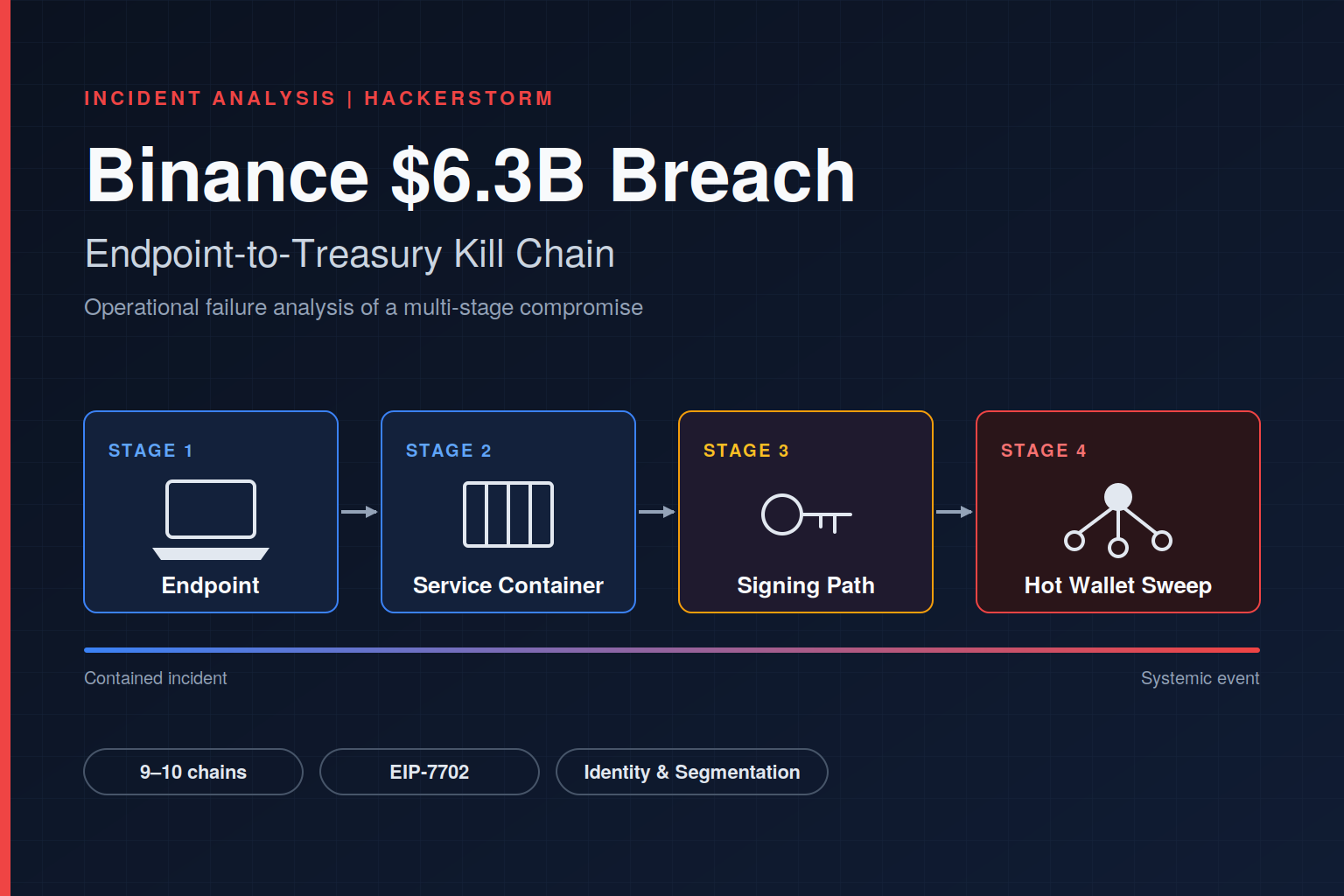
The payoff-to-effort ratio for nation-state actors targeting crypto infrastructure remains asymmetrically favourable. Expect repeat attempts with the same kill chain shape: endpoint, pipeline, signing path, sweep. [Inferred]
This is a developing incident. The questions below are unresolved as of 30 October 2026. This analysis will be revised as Binance, TRM Labs, Chainalysis, Blockaid and law enforcement publish further findings. Check back for updates.
1. How was the DevOps laptop compromised, and how did the attacker reach the service container and signing pipeline?
2. Was this key misuse via the signing service only, or did any key material leave Binance?
3. How were the 50 EIP-7702 authorisations produced, and by which system?
4. What is the correct chain count (10 vs 9) and hot wallet count?
5. Why was the delegation not cancelled until 00:10 UTC, and what prevented earlier revocation?
6. Did any internal velocity or circuit-breaker control trigger?
7. How long were credentials valid, and was there access before 29 Oct?
8. What are the final loss and frozen totals?
9. Will Binance publish a post-mortem, and does it confirm or contradict the [Inferred] items?
10. Is the TraderTraitor attribution corroborated beyond TRM and Chainalysis?
Update Log: to follow as story develops.
If you run a security programme, check this now:
▪ Are third-party and developer identities mapped in your asset inventory, including transitive reach to production?
▪ Are KEV-listed vulnerabilities and known-weaponised techniques auto-escalated with defined SLAs?
▪ Do credentials and sessions expire automatically, with just-in-time elevation for production access?
▪ Do you monitor egress and outflow velocity on sensitive data stores and treasury systems, with automated suspension triggers you have actually tested?
An endpoint compromise should resolve as a contained incident. The architecture decides whether it becomes a systemic event. In this case, the architecture decided within 20 minutes; the decision was not reversed until hours later, with external freezes beginning roughly 40 minutes in.
Lookup scores, news, poc's, threat intel, vendor advisory status, and exploit vectors in real time.
Ensure you understand operational related failures because failures are opportunities for learning and improving.
Reading Time: Approximately 15 minutes
This analysis is based on publicly available reporting and security research summaries. Some technical details may change as additional information becomes available.
Timur Mehmet | Founder & Lead Editor
Timur is a veteran Information Security professional with a career spanning over three decades. Since the 1990s, he has led security initiatives across high-stakes sectors, including Finance, Telecommunications, Media, and Energy. Professional qualifications over the years have included CISSP, ISO27000 Auditor, ITIL and technologies such as Networking, Operating Systems, PKI, Firewalls. For more information including independent citations and credentials, visit our About page.
Contact:
This article adheres to Hackerstorm.com's commitment to accuracy, independence, and transparency:
Editorial Policy: Ethics, Non-Bias, Fact Checking and Corrections
Learn More: About Hackerstorm.com | FAQs
▪ Binance Communications. (2026, October 30). Official update on safety incident investigation. Binance Newsroom / TradingView Live Updates: https://www.tradingview.com/news/cointelegraph:b8e523a16094b:0-live-updates-binance-says-6-3b-hack-involved-compromised-engineer-s-laptop/
▪ ABC News. (2026, October 30). Binance estimates security breach impact at $6.3 billion. ABC News: https://abcnews.com/Business/binance-estimates-security-breach-impact-63-billion/story?id=137698510
▪ Ynet News. (2026, October 30). Coverage of Binance Co-CEO Richard Teng's statement on the multi-stage nature of the Binance security incident. Ynet News: https://www.ynetnews.com/article/7khm9kg5e
▪ Blockaid Research. (2026, October 30). On-chain investigation into EIP-7702 exploit vector in Binance security incident. Blockaid Threat Intelligence / Crypto.news Analysis: https://crypto.news/binance-hack-eip-7702-wallet-attack/
▪ TRM Labs. (2026, October 30). North Korea steals USD 6.36 billion from Binance in the largest hack in history. TRM Labs Intelligence: https://www.trmlabs.com/resources/blog/north-korea-steals-usd-6-36-billion-from-binance-in-the-largest-hack-in-history
▪ Bitquery. (2026, October 30). Binance hack: $6.3B drained on 9 chains, $2.7B frozen. Bitquery Investigations: https://www.bitquery.io/investigations/binance-hack
▪ Gruschka, M. (2026, October 30). Binance hack: The DevOps laptop as entry point. DeViLink Consulting: https://www.devilink-consulting.com/en/blog/binance-hack-2026-devops-laptop-red-teaming
▪ Sky News. (2026, October 29). Crypto worth billions frozen over ‘potential security issue’. Sky News: https://news.sky.com/story/crypto-worth-billions-frozen-over-potential-security-issue-13605627
▪ CNBC. (2026, October 30). Binance's $6.3 billion hack: What we know and what comes next. CNBC: https://www.cnbc.com/2026/10/30/billions-in-crypto-frozen-in-binance-hack-heres-what-happens-next-.html
▪ Cointelegraph. (2026, October 30). North Korea's TraderTraitor linked to $6.3B Binance hack. Cointelegraph: https://cointelegraph.com/news/north-korea-linked-to-63b-binance-hack-by-crypto-investigators
▪ Levin, J. (2026, October 30). Chainalysis assessment attributing the Binance hack to DPRK group TraderTraitor. Statement on X, reported via Cointelegraph Live Updates: https://cointelegraph.com/news/live-updates-binance-63b-hack-linked-to-north-koreas-tradertraitor
▪ Wintermute Research. (2025, May 30). Analysis of EIP-7702 delegations and reused “CrimeEnjoyor” sweeper contracts. Statement on X, reported via CoinDesk: https://www.coindesk.com/tech/2025/06/02/post-pectra-upgrade-malicious-ethereum-contracts-are-trying-to-drain-wallets-but-to-no-avail-wintermute
▪ Unit 42. (2026, May 2). 2026 Unit 42 Global Incident Response Report: Accelerating AI-Driven Threats. Palo Alto Networks: https://www.paloaltonetworks.com/resources/research/unit-42-incident-response-report
▪ Zero Networks. (2026, March 31). 2026 Lateral Movement Exposure Report: Analysis of Enterprise Reachability. Zero Networks: https://zeronetworks.com/files/buyers-guides/ZN_2026_Lateral_Movement_Exposure_Report.pdf (See also product breakdown: https://zeronetworks.com/solutions/block-lateral-movement)
▪ CrowdStrike. (2026, February 24). CrowdStrike 2026 Global Threat Report: The Year of the Evasive Adversary. CrowdStrike: https://www.crowdstrike.com/en-us/global-threat-report/
COOKIE / PRIVACY POLICY: This website uses essential cookies required for basic site functionality. We also use analytics cookies to understand how the website is used. We do not use cookies for marketing or personalization, and we do not sell or share any personal data with third parties.